
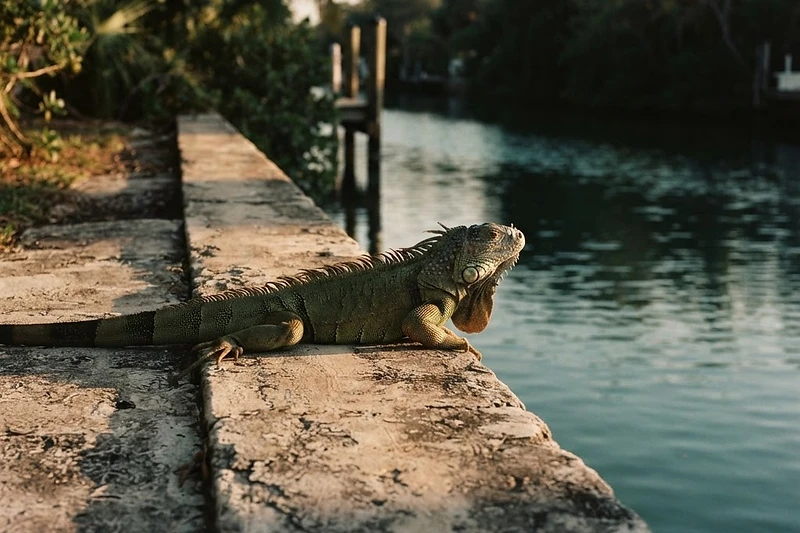
What plants do iguanas eat — and which they tend to avoid
Iguanas eat a wide range of landscape plants, and the ones they prefer include hibiscus, bougainvillea, impatiens, orchids, roses, leafy greens, and many fruits — they are particularly fond of hibiscus flowers and tender new growth on almost any shrub. They also eat the leaves of trees like schefflera and sea grape.
Plants they tend to avoid include oleander, crotons, society garlic, lantana, and plants with thick, waxy, or fuzzy leaves. If you are in an area with heavy iguana pressure, choosing plants iguanas tend to avoid is the single most effective long-term strategy for protecting your landscaping. UF/IFAS publishes a list of iguana-resistant plants suited to South Florida conditions. No plant is completely iguana-proof — a hungry iguana will try almost anything — but planting species they tend to skip makes a measurable difference.
Why iguanas burrow into seawalls and banks
Iguanas burrow into seawalls, canal banks, and slopes because they need underground dens for shelter and egg-laying. A female iguana digs a burrow in soft soil — often the earth behind a seawall cap or the slope of a canal bank — and the burrow can extend several feet deep.
Over time, multiple iguanas using the same bank create a network of burrows that can undermine the structural integrity of a seawall or canal bank, leading to erosion and, in severe cases, collapse. This is not a minor concern for canal-front properties — the burrows weaken the soil behind the seawall, and the cost of repairing a failed seawall is significant. Filling existing burrows (after confirming they are empty) and making the bank less diggable — with rocks, netting, or dense low plantings — helps protect the structure.
Iguanas in the pool and on the pool deck
Iguanas end up in pools because they are attracted to the water for drinking and the sunny pool deck for basking. A green iguana can swim, so it will not drown immediately, but it may have trouble climbing out of a smooth-walled pool and can become trapped.
If you find an iguana in your pool, use a pool net or a board to give it a ramp to climb out — do not try to grab it by hand, as iguanas can bite and their tails can deliver a strong whip. To keep iguanas off the pool deck, reduce the plants they eat near the pool area, and run a granular band along the edge of the deck and the transition from the deck to the landscaping. Remove any food source (fallen fruit, flowering plants) from the pool area. The less reason an iguana has to come to the pool, the less likely it is to end up in it.
How to keep iguanas out of a yard and garden
To keep iguanas out of a yard and garden, protect or replace the plants they eat, block the burrowing sites, and create an unpleasant perimeter along the routes they use to enter. Wrap the trunks of preferred plants like hibiscus with metal flashing or tree wrap so iguanas cannot climb them.
Install mesh fencing around garden beds — iguanas are heavy and cannot climb fine mesh as easily as they climb stucco. Fill empty burrows behind seawalls and along canal banks, and cover the soil with rocks or netting to discourage new digging. Run a granular band along seawall caps, foundation lines, and the transitions from landscaping to hardscape — the routes iguanas use to move between basking spots and burrow sites. One application lasts two to three weeks. The combination of removing food, blocking burrows, and banding travel routes is what produces results.
Iguana droppings and property damage
Iguana droppings are a significant property issue because iguanas return to the same basking spots daily, and they leave large, messy droppings on seawalls, docks, pool decks, and patios. The droppings can carry salmonella, and they stain surfaces if left in place.
Beyond droppings, iguanas cause damage by stripping plants — a single iguana can defoliate a hibiscus in a day — and by burrowing into seawalls and canal banks, which can undermine the structure over time. They also dig in garden beds, disturb mulch, and leave scratches on surfaces they climb. The damage is cumulative: a few iguanas visiting daily over a season can destroy thousands of dollars in landscaping and create a persistent cleanup burden. Addressing the problem early, before iguanas establish a daily routine on your property, is far easier than dealing with an established population.
Florida rules and FWC context
Green iguanas are an invasive species in Florida and are not protected under state law — FWC classifies them as a nonnative species that can be removed from private property with the property owner's permission. However, iguanas may not be relocated and released elsewhere; they must be removed humanely or kept on the property.
FWC recommends that property owners use humane methods and, when in doubt, hire a permitted wildlife removal professional. The FWC website provides guidance on iguana management and a list of permitted trappers by county. It is also illegal to use certain control methods (poisons, for example) on iguanas or any wildlife. The repellent approach — making the property unpleasant so iguanas reroute on their own — is consistent with FWC guidance, because it does not involve capturing, relocating, or harming the animals.
What does NOT work
Fake owls and plastic predators do not work on iguanas for more than a day or two — iguanas are observant and quickly recognize a stationary decoy as no threat. Coffee grounds have no demonstrated repellent effect on iguanas. Mothballs are illegal for outdoor use and toxic to pets and children. Ultrasonic and sound-emitter devices have no effect on iguanas.
A one-and-done spray or device does not work, because iguanas return to the same basking and feeding spots day after day as long as the food, sun, and burrow sites that drew them remain. No single product solves an iguana problem by itself — removing the food source, blocking the burrows, and maintaining a perimeter along travel routes is the only approach that produces lasting results.
About the powder
ReptilesAway is a granular powder — not a spray — that you shake along seawall caps, canal banks, and foundation lines where iguanas travel between basking and burrow sites. It is formulated as an EPA FIFRA 25(b) minimum-risk pesticide — made only from ingredients on the EPA's minimum-risk list, so it is exempt from federal registration.
The 32 oz bag ($24.99) covers about 1,500 sq ft; the 5-gallon bucket ($164.99) covers about 30,000 sq ft. One application lasts two to three weeks. The five ingredients — sodium chloride, citric acid, lemongrass oil, peppermint oil, and garlic oil — are printed on every bag. Made in Fort Lauderdale, Florida, with a 30-day money-back guarantee. For local treatment in Miami-Dade, Broward, or Palm Beach, call 1-833-8REPTILES (1-833-873-7845) for a quote — no contracts.
Made with food-grade and botanical ingredients. As with any product, keep pets from eating it directly and check the ingredient list if your pet has known sensitivities to any of them.
To keep iguanas off your property, lay a granular band along the travel routes described above. The 32 oz bag covers 1,500 sq ft — enough for a typical yard perimeter. For a full perimeter or a large lot, the 5-gallon bucket covers 30,000 sq ft. See our application guide for the three-step method.
Common questions
What plants do iguanas eat in Florida?
Iguanas eat hibiscus, bougainvillea, impatiens, orchids, roses, and many fruits and leafy greens. They tend to avoid oleander, crotons, society garlic, and lantana. Planting iguana-resistant species is the most effective long-term strategy. UF/IFAS publishes a list of iguana-resistant plants suited to South Florida conditions.
Why do iguanas burrow into seawalls?
Iguanas dig burrows in the soft soil behind seawalls and along canal banks for shelter and egg-laying. Over time, multiple burrows can undermine the structural integrity of the seawall, leading to erosion and potential collapse. Filling empty burrows and covering the soil with rocks or netting helps protect the structure.
How do I keep iguanas away from my pool?
Remove plants they eat near the pool, pick up fallen fruit, and run a granular band along the pool deck edge and the transition to landscaping. If an iguana is in the pool, use a net or board as a ramp — do not grab it by hand. They can swim but may struggle to climb out of a smooth-walled pool.
How do I get rid of iguanas in my yard?
Protect or replace the plants they eat, fill empty burrows, wrap tree trunks with metal flashing, and run a granular band along seawall caps and foundation lines. Green iguanas are an invasive species in Florida and are not protected, but FWC requires humane methods and prohibits relocation. Call a permitted trapper if needed.
Are iguanas protected in Florida?
No. Green iguanas are classified as an invasive nonnative species by FWC and are not protected under state law. They may be removed from private property with the owner's permission, but they may not be relocated and released elsewhere. FWC recommends humane methods and hiring a permitted wildlife removal professional when in doubt.