

Bayfront and riverfront: the iguana neighborhoods
The City of Miami's iguana pressure sits where the land meets Biscayne Bay, the Miami River, and the Little River. Coconut Grove — Center Grove, Northeast Grove, Southwest Grove, and the bayfront lots near Kennedy Park and The Barnacle — has the hardwood canopy and seawalls that let green iguanas move from tree to dock to pool without touching open ground. The Upper Eastside has the same layout on a smaller scale: Morningside, Belle Meade, Bay Point, Shorecrest, Palm Grove, and the Bayside Historic District are 1920s–40s Mediterranean and Deco homes with docks on the bay or on the canals that feed the Little River. Spring Garden sits on the Seybold Canal and the river. The Venetian Islands and Brickell Key are seawall on every side.
On all of them the pattern is identical: iguanas sun on the seawall cap, burrow into the bank behind it and under pool decks, foul the dock, and strip hibiscus, bougainvillea, and orchids. The city does not run a removal program of its own; it points residents to a private vendor through its Buy Miami discounts. The February 2026 cold snap dropped iguanas out of trees across the city and the FWC's regional office took in more than a thousand in a day, but the bay refilled the seawalls by spring.
Inland Miami: pools, canals, and toads
West of the Grove and Brickell, the problem shifts. Flagami sits on the Tamiami Canal and Blue Lagoon; Shenandoah, Coral Way, Allapattah, and Little Havana are older bungalow and ranch streets with porch lights and small pools. Cane toads breed in the canals and in any neglected pool, come up after rain, and sit under landscape lights — a South Florida dog died within seconds of yard contact in late 2024, and they are toxic to dogs generally. Cuban tree frogs breed in the same pools, pack into pump housings, and get into houses through roof vents. Geckos and anoles work every lit entryway. Simpson Park's hammock in Brickell and Alice Wainwright Park's bayfront hammock in the north Grove keep both iguanas and frogs supplied right up against residential streets.
Where to lay the band in Miami
Bay and river lots (Grove, Upper Eastside, Spring Garden, Venetian Islands): a continuous band on the dry seawall cap, the dock landing, the lawn strip to the pool, and the base of any hedge being stripped. Inland streets (Flagami, Shenandoah, Coral Way): the foundation line, the outside footer of the pool cage or the pool-deck edge, and a ring around each low landscape light and the pump pad; on the Tamiami Canal, add the canal bank.
Miami is about 28 miles south of our Fort Lauderdale base, and we run Miami-Dade routes that pair the Grove and Upper Eastside with Coral Gables and Miami Beach. A bayfront Grove lot with a long seawall is a 5-gal job; a Shenandoah bungalow with a small pool is a 32 oz bag. Condo associations on Brickell Key or the Venetian Islands can request a common-area walk-through.
A barrier you control, from five ingredients you can read.
ReptilesAway is a granular powder, not a spray, made from five ingredients — sodium chloride, citric acid, lemongrass oil, peppermint oil, and garlic oil — and formulated as an EPA FIFRA 25(b) minimum-risk pesticide — made only from ingredients on the EPA's minimum-risk list, so it is exempt from federal registration. One application lasts 2–3 weeks. The 32 oz bag is $24.99 and covers 1,500 sq ft; the 5-gal bucket is $164.99 and covers 30,000 sq ft. Made with food-grade and botanical ingredients. As with any product, keep pets from eating it directly and check the ingredient list if your pet has known sensitivities to any of them. Local treatment is priced by quote with no contracts — call 1-833-8REPTILES (1-833-873-7845).
See how it works- Sodium chloride01
- Citric acid02
- Lemongrass oil03
- Peppermint oil04
- Garlic oil05
Buy what you need.
Free shipping on orders of $100 or more. Flat $8.95 under that.

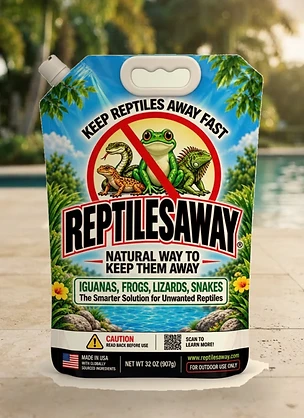
Label mockup shown. Final packaging may vary.
ReptilesAway Powder · 32 oz
1,500 SQ FT · 2–3 WEEKS PER APP$24.99


Label mockup shown. Final packaging may vary.
ReptilesAway Powder · 5-Gallon
30,000 SQ FT · 2–3 WEEKS PER APP$164.99
Three steps. You run them.
Find the travel lines
Walk your Miami property and flag the routes reptiles use — bayfront seawalls, canal banks, pool-cage edges, the gaps under a gate off Coral Way.
Lay the band
Shake a three-foot band of powder along those lines. No spray, no fogger, nothing to dry — fine around the pool and patio.
Reapply on schedule
One pass lasts two to three weeks. Reapply after a heavy rain or every couple of weeks through Miami's long iguana season.
Questions about Miami.
Iguanas are burrowing under my Coconut Grove pool deck. Will the powder help?
It discourages them from using the seawall cap and the lawn strip that leads to the deck, which is where burrowing starts. Run the band on the dry cap, the dock landing, and along the deck edge, and reapply every two weeks in summer. A deck that has already settled should be checked by a contractor.
I found a cane toad by the dog's water bowl in Flagami. What do I treat?
Ring each low landscape light and the pool-equipment pad, run the band along the canal bank if you are on the Tamiami Canal, and along the foundation and pool-deck edge. Toads are most active May through October after rain, so keep the band fresh then and keep dogs away from any toad you find.
Can a condo or HOA on the Venetian Islands book a common-area treatment?
Yes. We walk the seawall, dock area, and landscaped edges with the manager, mark the travel lines, and send a per-visit quote for a single treatment or a recurring schedule with no annual contract. Nothing is sprayed, so there is no drift onto units or the bay.
Take back your Miami yard.
From the Grove to Flagami, the fix is the same: a granular line where the reptiles travel. Run it yourself, or let our crew handle the whole thing.