
Edges, bands, and a schedule.
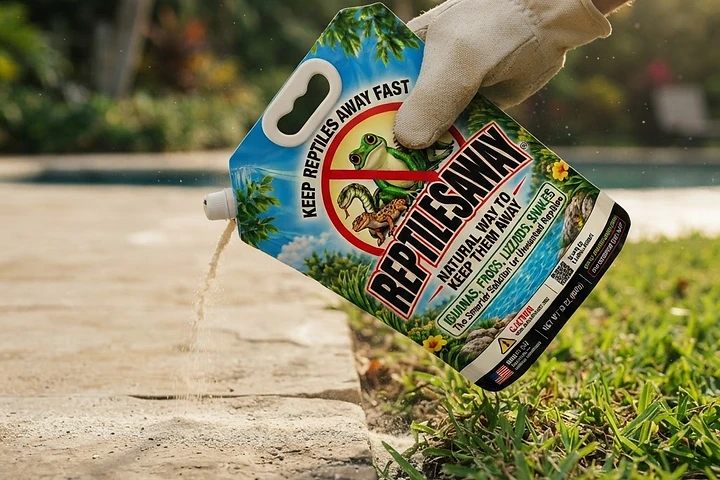
Identify the travel lines
Reptiles and amphibians are creatures of edges. They move along foundation lines, seawalls, fence lines, pool-cage thresholds, mulch-bed edges, and the gaps under doors — the routes between cover and food. Walk the property and flag those routes.
Apply a three-foot band
Shake or spread the powder in a band about three feet wide along each route. No spray, no fogger, no mixing, no drying time. It goes exactly where you want it and stays there — safe to put down around the pool, the patio, and the lanai.
Reapply every 2–3 weeks
One application lasts two to three weeks. Reapply after a heavy rain or on your own schedule through the season. The reptiles don't forget — they keep choosing the easier, unbanded route.
Find the travel lines
Reptiles and amphibians are edge-followers. They don't cross open lawn at random — they move along structural edges where cover meets open ground. On a South Florida property, those edges are the foundation line where the slab meets the landscaping, the cap of a seawall or canal bank, the fence line, the threshold where a pool cage screen meets the concrete footer, the edge of a mulch bed, and the gap under a door or gate.
Walk the property in the morning, when iguanas are basking and lizards are active. Note where you see reptiles and, more importantly, the route they take to get there. The seawall cap an iguana walks every morning, the foundation line anoles follow to reach the porch light, the mulch-bed edge a snake travels along — those are your travel lines. You don't need to treat the whole yard. You need to treat the lines the animals actually use.
Lay a three-foot band
Once you've identified the travel lines, shake or spread the powder in a band about three feet wide along each one. No spray, no fogger, no mixing, no drying time. The granular powder goes exactly where you put it and stays there — safe to lay down around the pool, the patio, and the lanai.
A three-foot band is wide enough that a reptile can't step over it in a single stride. It's narrow enough that you're not wasting product on areas the animals don't cross. You're not broadcasting it across the lawn — you're laying a barrier across the routes.
Where the band goes on a canal lot, a pool cage, and a standard yard
Canal lot.
Lay a continuous band along the dry seawall cap, the dock landing, and the strip of grass between the water and the pool. Add a band at the base of any hedge being stripped. If the dock has a ramp or steps, ring the landing. Canal-front properties are the highest-pressure scenario — the seawall cap is the main travel line, and the band needs to cover the full run.
Pool cage.
Lay the band along the outside footer of the pool cage — the concrete base the screen attaches to. This is where frogs, geckos, and anoles travel along the base of the screen to reach the lights that draw insects. Ring each low landscape light and the pool-equipment pad, which is where cane toads and tree frogs gather after dark.
Standard yard.
Lay the band along the foundation line, the fence line, and the edge of any mulch bed that borders the lawn. Add a band across the threshold of the garage door and any side doors. If the yard backs onto a preserve or canal, treat the fence line on that side.
How much to use
The 32 oz bag covers about 1,500 square feet — enough for a typical single-family yard perimeter. The 5-gallon bucket covers about 30,000 square feet — for large lots, canal-front properties with a long seawall run, or professionals treating multiple properties.
The key word is "lines." You're treating the linear footage of the travel routes, not broadcasting across the entire lawn. A 1,500-square-foot coverage figure means 1,500 square feet of banded travel lines — roughly 500 linear feet of three-foot-wide band. Most residential perimeters need one 32 oz bag. A canal lot with a full seawall run may need the 5-gallon bucket.
Reapply every 2–3 weeks, sooner after heavy rain
One application lasts two to three weeks in normal South Florida conditions. Rain, irrigation, and UV break down the band over time. A granular powder is more resistant to washout than a liquid spray — it sits on the surface rather than bonding to it — but a heavy rain will still degrade it.
After a storm that drops an inch or more of rain, check the banded routes and reapply if the powder has been washed away or compacted. If you have sprinklers that hit the banded area, they will shorten the life of the application — lay the band outside the irrigation spray zone when possible.
Through the active season — spring through fall in South Florida — stay on a two-to-three-week reapply cycle. In the cooler months, reptiles are less active and you can stretch the interval.
What to do before the first application
Before you lay the band, take thirty minutes to reduce the attractants that drew the reptiles in the first place:
- Remove food sources. Pick up pet-food bowls at night. Switch outdoor lights to warm or yellow LED bulbs, which attract fewer insects — fewer insects means fewer frogs and lizards. Turn off non-essential lights after 10 p.m.
- Fill burrows. If iguanas have dug burrows behind your seawall or along a canal bank, fill them after confirming they are empty. Cover the soil with rocks or netting to discourage new digging.
- Trim overhanging growth. Cut branches that overhang the water or the seawall — iguanas use them to access the cap. Thin the bottom branches of shrubs so they don't touch the ground, which removes cover for snakes and their prey.
These steps make the yard less attractive, which makes the band more effective. The combination is what produces lasting results — a repellent alone, without reducing the attractants, is a partial solution.
What it will not do
ReptilesAway does not kill, trap, or relocate reptiles. It makes their travel routes unpleasant so they reroute off the property over a few days, unharmed. It does not remove the food, water, or shelter that drew them — you handle that with lighting changes, habitat reduction, and physical exclusion.
It will not stop a determined iguana from reaching a hibiscus it loves if there is an unobstructed path to it. It will not keep a venomous snake out of your house — if you have a venomous snake indoors, call a licensed wildlife removal professional. It will not solve a heavy, established infestation on its own — combine it with habitat reduction, physical exclusion, and professional removal when needed.
ReptilesAway is formulated as an EPA FIFRA 25(b) minimum-risk pesticide — made only from ingredients on the EPA's minimum-risk list, so it is exempt from federal registration. The five ingredients — sodium chloride, citric acid, lemongrass oil, peppermint oil, and garlic oil — are printed on every bag. Made with food-grade and botanical ingredients. As with any product, keep pets from eating it directly and check the ingredient list if your pet has known sensitivities to any of them. For local treatment in Miami-Dade, Broward, or Palm Beach, call 1-833-8REPTILES for a quote — no contracts.
A barrier you control, from five ingredients you can read.
Not a spray. A granular powder you shake or spread along the lines reptiles travel — foundation lines, seawalls, fence lines, pool cages, doorframes, garden beds, AC pads. One application lasts 2–3 weeks. Reapply after heavy rain or every 2–3 weeks.
See how it works- Sodium chloride01
- Citric acid02
- Lemongrass oil03
- Peppermint oil04
- Garlic oil05
Run it yourself.
Buy the powder and apply it on your own schedule. No contracts, no spray, no waiting on a crew.