

Our home city has the worst seawall problem in Broward
Fort Lauderdale has more than a hundred and sixty miles of navigable canals, and the neighborhoods built on them are where our phone rings most. Las Olas Isles, Seven Isles, Idlewyld, Nurmi Isles, Harbor Beach, Rio Vista on the New River, Tarpon River, Coral Ridge east of Bayview Drive, Bay Colony, The Landings, and Lauderdale Isles and Riverland out on the New River's south fork all share the same layout: a seawall, a dock, a strip of lawn, a pool, and a hibiscus or bougainvillea hedge. Green iguanas run that whole line. They sun on the seawall cap, burrow into the bank behind it, foul the dock and pool deck, and strip the hedge. Every canal is a highway, so removing one animal opens the slot for the next one that swims over from the neighbor's dock.
The February 2026 cold snap showed the scale. Television crews filmed stunned iguanas along Las Olas Boulevard, the FWC opened a two-day window for the public to collect them, and the state counted several thousand turned in across the region. By late spring the seawalls were repopulated. A cold morning is not a plan.
Inland streets have a different pest list
Victoria Park, Middle River Terrace, Imperial Point, and Coral Ridge Country Club Estates are dry-lot or golf-edge neighborhoods with mature canopy, porch lights, and screened patios. The dominant call there is Cuban tree frogs on lit windows and inside pool cages, geckos in the entryway, and anoles on every stucco wall. Along the Middle River and near Hugh Taylor Birch State Park — where iguanas are far more common than alligators and dive off the banks into the water — a canal-side lot gets both lists at once. Cane toads show up around pools and dog bowls in the wetter western neighborhoods after summer rain, and they are toxic to dogs.
Where to lay the band in Fort Lauderdale
Canal homes: a continuous band along the dry seawall cap, the dock landing, the grass strip to the pool, and the base of the hedge. If the dock has a ramp or steps, ring the landing. Inland homes: the foundation line, porch steps, the outside footer of the pool cage, and a ring around every low landscape light. Riverland and Lauderdale Isles lots that back onto Secret Woods should treat the fence line on the woods side.
Fort Lauderdale is our base, so there is no travel window: we can usually walk a Las Olas Isles or Rio Vista property within days of the call, and the 5-gal bucket goes on the truck for any lot with a full seawall run. Victoria Park bungalows and Coral Ridge dry lots are a 32 oz bag.
A barrier you control, from five ingredients you can read.
ReptilesAway is a granular powder, not a spray, made from five ingredients — sodium chloride, citric acid, lemongrass oil, peppermint oil, and garlic oil — and formulated as an EPA FIFRA 25(b) minimum-risk pesticide — made only from ingredients on the EPA's minimum-risk list, so it is exempt from federal registration. One application lasts 2–3 weeks. The 32 oz bag is $24.99 and covers 1,500 sq ft; the 5-gal bucket is $164.99 and covers 30,000 sq ft. Made with food-grade and botanical ingredients. As with any product, keep pets from eating it directly and check the ingredient list if your pet has known sensitivities to any of them. Local treatment is priced by quote with no contracts — call 1-833-8REPTILES (1-833-873-7845).
See how it works- Sodium chloride01
- Citric acid02
- Lemongrass oil03
- Peppermint oil04
- Garlic oil05
Buy what you need.
Free shipping on orders of $100 or more. Flat $8.95 under that.

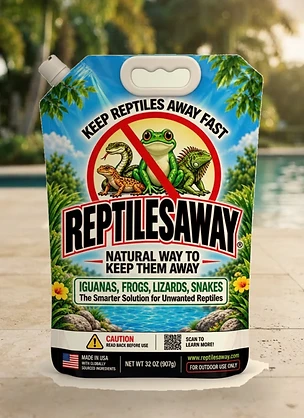
Label mockup shown. Final packaging may vary.
ReptilesAway Powder · 32 oz
1,500 SQ FT · 2–3 WEEKS PER APP$24.99


Label mockup shown. Final packaging may vary.
ReptilesAway Powder · 5-Gallon
30,000 SQ FT · 2–3 WEEKS PER APP$164.99
Three steps. You run them.
Find the travel lines
Walk your Fort Lauderdale property and flag the routes reptiles use — Intracoastal seawalls, foundation lines, pool-cage edges, the gaps under a side gate.
Lay the band
Shake the powder in a three-foot band along those lines. No spray, no fogger, nothing to dry — safe to put down around the pool and the lanai.
Reapply on schedule
One pass lasts two to three weeks. Reapply after a heavy rain or every couple of weeks through iguana and tree-frog season.
Questions about Fort Lauderdale.
My Las Olas Isles seawall has iguana burrows behind it. Where exactly does the powder go?
On the dry seawall cap, the dock landing, and the lawn strip between the water and the pool — the three lines every iguana crosses to reach the yard. Reapply every two weeks in summer, since tide splash and afternoon storms shorten the interval. A cap that has already dropped should be checked by a marine contractor.
Do you treat gated neighborhoods like Seven Isles, Harbor Beach, or Bay Colony?
Yes. We coordinate the gate with you or the association, walk the lot, and send a quote for a single visit or a recurring schedule with no contract. Several neighbors treating at once works better on a finger island, because iguanas move across the canal to whichever seawall is untreated.
Tree frogs cover my Victoria Park pool cage every night. Is this the right product?
Yes. Cuban tree frogs sit on lit screens and around pool lights, so run the band along the outside footer of the cage and ring the low landscape lights and the pump pad. Nothing is sprayed and nothing dries, so the pool stays in use, and the ring can be refreshed after any storm.
Take back your Fort Lauderdale yard.
Whether you're on the canals in Coral Ridge or inland in Victoria Park, the fix is the same: a granular line where the reptiles travel. Run it yourself, or let our Fort Lauderdale crew handle the whole thing.