
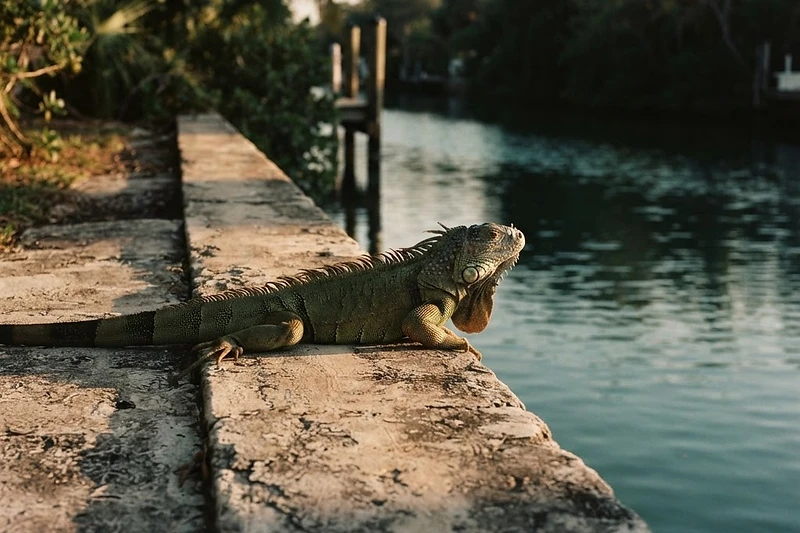
Iguana repellent and iguana removal solve different problems: repellent makes the iguanas that use your property reroute off it on their own, over a few days, and keeps new ones from moving in as long as the band is maintained; removal physically relocates the specific iguanas that are there today. Most South Florida yards need repellent on a schedule, because removal alone doesn't stop the next iguana from taking the same basking spot.
What iguana repellent does
A repellent doesn't touch the iguana. It changes the route. You lay a three-foot band of granular powder along the seawall cap, the canal bank, the foundation line, or the dock edge — the travel lines iguanas use to move between their basking spots and their burrows. The iguanas avoid the banded section and, over a few days, start using a different route that doesn't cross your patio or your seawall.
The key word is "reroute." The iguanas don't die, they don't get trapped, and they don't get relocated by you — they choose a different path on their own. Once the band is in place and maintained on a two-to-three-week cycle, your stretch of seawall or canal bank becomes the part of the local iguana route they skip. New iguanas that move into the area encounter the same banded line and make the same choice.
For the full approach — behavior, travel lines, and application — see our iguanas page.
What iguana removal means
Removal is different. A licensed nuisance-wildlife trapper physically captures the iguanas on your property and relocates or euthanizes them according to Florida wildlife regulations. It's a one-time, hands-on operation: the trapper comes out, removes the iguanas that are there that day, and leaves.
Removal is immediate — the iguanas on your seawall this morning are gone this afternoon. But it's also a snapshot. The burrows, the basking spots, the food source, and the canal route that drew those iguanas in the first place are all still there. Within days or weeks, new iguanas from the same canal population can move into the vacated territory and pick up the same habits.
The honest comparison
Here's how the two approaches stack up, property by property.
Speed
Removal is faster today. The iguana on your dock this morning is gone by this afternoon. Repellent takes a few days — the iguanas encounter the band, start avoiding the route, and reroute over the course of a week or so. If you need the seawall clear for an event tomorrow, removal is the faster option. If you're solving a recurring problem, the few-day lead time on repellent doesn't matter.
Lasting effect
This is where the two diverge sharply. Removal clears what's there today and nothing more. The same seawall, the same canal, the same hibiscus will draw the next iguana. Repellent, maintained on schedule, keeps working — the band stays in place, and every iguana that tries the route encounters it. A maintained repellent line is ongoing protection; a removal visit is a single clearance.
Effort
Repellent is a bag of powder and a few minutes every two to three weeks. You shake it along the travel lines yourself, or our crew does it on a treatment visit. Removal requires scheduling a trapper, and in many Florida municipalities there are rules about who can do it and how — it's not a DIY task.
What happens to the iguanas
Repellent leaves the iguanas unharmed — they reroute to a different stretch of canal or a neighbor's seawall. Removal means the iguanas are physically handled and relocated or euthanized per state wildlife guidelines. If leaving the animals unharmed matters to you, repellent is the approach that does that.
Which one solves your problem?
The question is whether your problem is "the iguanas that are here right now" or "the fact that iguanas keep showing up."
If a single large iguana has taken up residence in a spot you can't band — say, it's burrowed under a structural feature and you need it gone before a repair — removal is the right tool for that moment.
If your problem is the recurring pattern — iguanas on the seawall every morning, droppings on the dock, new ones replacing the ones you chase off — that's a repellent problem. The recurring pattern means the route and the attractants are still there, and the only thing that breaks it is making the route itself unpleasant to use. That's what a maintained granular band does.
On a canal-front property in Boca Raton or anywhere along the Intracoastal, the recurring pattern is the norm — the canal population is established and individuals cycle through. Removal clears the current resident; repellent clears the route for everyone who follows.
They work together
It's not always either-or. A property with a heavy, established iguana presence can benefit from a one-time removal to clear the worst of it, followed by a maintained repellent band to keep the route closed going forward. The removal handles the immediate problem; the repellent handles the recurring one.
But if you're choosing one approach for a typical South Florida yard, repellent on a schedule is the one that actually solves the recurring problem. Removal alone, without anything to stop the next iguana from taking the same spot, is a recurring expense and a recurring call.
Getting started
If you want to run the repellent yourself, the 5-gallon bucket covers a full seawall-and-dock perimeter; the 32 oz bag handles a smaller stretch. Lay the band, maintain it every two to three weeks, and the route stays closed.
If you'd rather have the crew handle the whole thing — walkthrough, banding, and scheduled maintenance, no contracts — book a treatment and we'll run it start to finish. Or browse both options at the shop.