
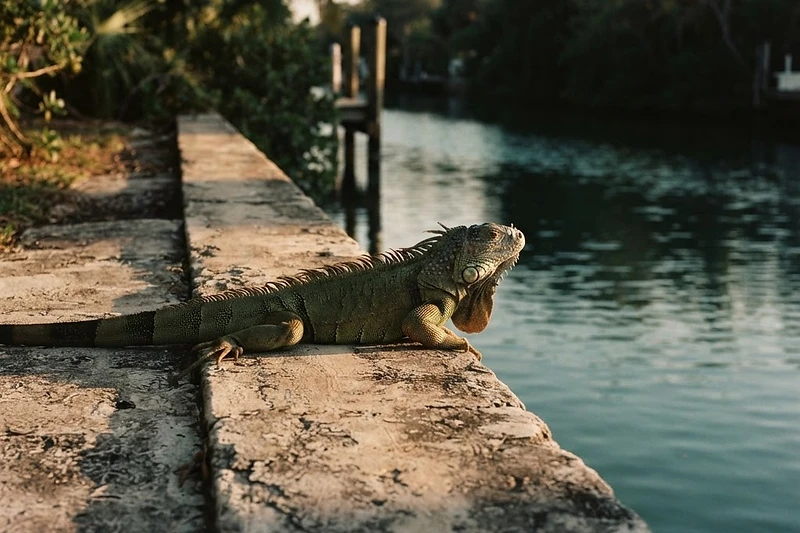
The quickest way to keep iguanas off a seawall or dock is to lay a three-foot band of granular repellent along the edge they use to climb up and bask. They avoid the banded section and reroute off the property within a few days, unharmed. One application lasts two to three weeks.
Why iguanas love your seawall and dock
South Florida's seawalls and docks are built for people, but they happen to be perfect for iguanas. A seawall gives a green iguana everything it wants in one place: a flat, sunny surface to bask on through the morning, immediate access to water, and a vertical face it can climb at any angle. Docks add the warmth of the decking boards and the shelter of the pilings underneath.
Iguanas are cold-blooded, so they need morning sun to get moving. A seawall that faces east or south heats up first, and the iguanas that live along your stretch of canal know exactly which section catches sun earliest. They return to the same spot every morning — and that predictability is the whole opportunity.
The travel line is the key
An iguana on your seawall didn't appear there by chance. It came up a specific route — usually the cap of the seawall, a corner where the wall meets the dock, or a gap where the seawall meets the landscaping. That route is the travel line. You don't need to treat the entire yard — you need to treat the line the iguanas actually use.
What's attracting them
Three things, almost always:
- Warm sun on a hard surface. Seawall caps, dock decking, and concrete patios hold heat. Iguanas bask there from early morning through midday.
- Open water. Canal-front and Intracoastal properties give iguanas a drinking source and an escape route — they drop into the water and swim off if startled.
- Edible landscaping. Hibiscus, bougainvillea, and impatiens are iguana favorites. A flowering hedge near the seawall is a buffet next to a basking spot.
If you're on a canal in Fort Lauderdale or anywhere along the Intracoastal, you've got all three. That's why canal-front properties see the same iguanas on the same stretch of seawall day after day.
The perimeter approach
The goal isn't to trap or harm the iguanas — Florida wildlife rules discourage that. The goal is to make the routes they already use unpleasant enough that they reroute. A three-foot band of granular powder along the seawall cap, the dock edge, and the transition from the dock to the landscaping does exactly that.
1. Find the travel lines
Walk your seawall and dock in the morning while the iguanas are basking. Note where they sit and, more importantly, the route they take to get up there. The seawall cap, the dock-to-landscape transition, and any corner where two surfaces meet are your travel lines.
2. Lay the band
Shake the powder in a three-foot band along those lines. You're not dusting the whole seawall — you're laying a band across the routes. No spray, no fogger, nothing to mix or dry. The 5-gallon bucket is the right size for a full seawall-and-dock perimeter on a canal lot; the 32 oz bag covers a smaller stretch.
3. Reapply on a schedule
One application lasts two to three weeks. Through iguana season — which in South Florida runs from early spring through late fall — reapply after a heavy rain or every couple of weeks. The iguanas don't forget the banded route; they keep choosing the easier, unbanded path.
Why a granular band beats a spray on a seawall
Sprays and liquids don't hold up on a seawall. The surface is hot, the sun is direct, and the splash zone from the canal eats anything you've painted on. A dry granular powder sits on top of the cap and the dock edge and stays where you put it — no drying time, no runoff into the canal, no drift onto the decking where people walk.
It's also more precise. A spray coats everything; a granular band goes only on the travel line, so you're not putting product where it isn't needed.
What about the burrows?
Iguanas dig burrows, and a seawall or canal bank is a favored spot — the soil is soft, the slope is already there, and the burrow entrance is hidden by the cap. Burrows that undercut a seawall can weaken the wall over time, which is a real structural concern on older canal-front properties.
A granular band along the seawall cap doesn't fill the burrow — it changes the route. Once the cap is banded, the iguanas stop using that stretch as a daily corridor, and the burrow gets less traffic. If a burrow is already undermining the seawall, that's a repair issue for a seawall contractor; the repellent keeps new traffic off the line going forward.
Seasonal timing
Iguana activity in South Florida peaks from spring through early fall, when the mornings are warm enough for sustained basking. That's the window to stay on a two-to-three-week reapply cycle. In the cooler months, iguanas are less active and you can stretch the interval — but a band left in place through winter gives you a head start when the weather warms and the iguanas come back to the same wall.
Iguanas are creatures of habit
Green iguanas in South Florida are established. They've been here for decades and they're part of the landscape. What you can do is make your stretch of seawall and dock the part of their daily route they skip. Once the band is down and maintained, the iguanas that used to bask on your wall start using a neighbor's wall or a canal bank down the way. You haven't solved the regional iguana population — you've solved the one on your property.
For the full species breakdown — behavior, what draws them, and the repellent approach — see our iguanas page.
When to call a crew
If your seawall is long, the dock is large, or you'd rather not handle it yourself, our crew runs treatments across Broward, Miami-Dade, and Palm Beach counties. We walk the property, lay the bands, and maintain them on a schedule — no contracts. Book a treatment and we'll handle it start to finish.
Prefer to run it yourself? Shop the powder and lay the band this weekend.