
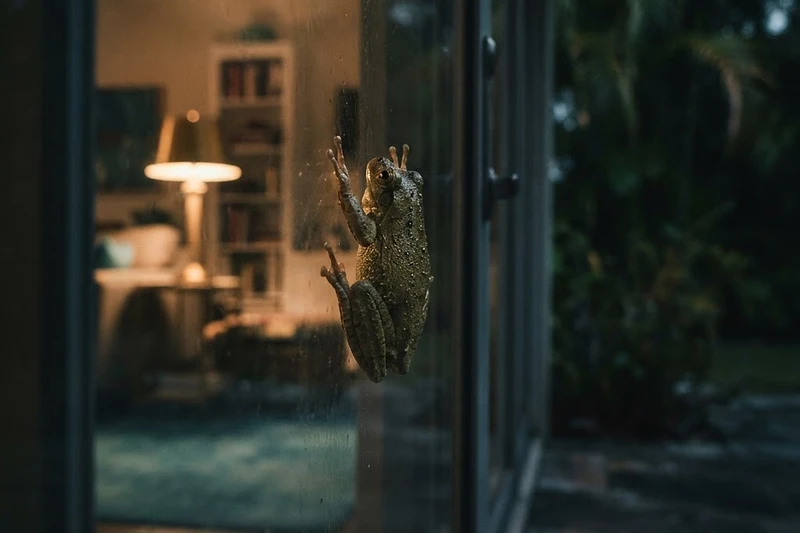
Cuban tree frog vs native Florida tree frogs
Cuban tree frogs are larger than any native Florida tree frog — adults commonly reach 2 to 5 inches, while native species like the squirrel tree frog and green tree frog stay under 2.5 inches. Cuban tree frogs have rough, warty skin and come in colors ranging from gray-brown to pale green to almost white, often with mottled patterns.
Native tree frogs tend to be more uniform in color and have smoother skin. The most reliable identifier is size: if a tree frog on your window looks as big as your fist, it is almost certainly a Cuban tree frog. UF/IFAS provides identification photos that compare Cuban tree frogs side by side with native species, which is worth reviewing if you want to confirm what you are seeing.
Why frogs sit on windows, doors and lanai screens at night
Frogs sit on windows, doors, and lanai screens at night because the light shining through attracts flying insects, and the insects are the frog's food. A lit window or a porch light is a feeding station — the frog sits where the food gathers. After a warm summer rain, insect activity spikes, and the number of frogs on windows and screens spikes with it.
Cuban tree frogs are also opportunistic: they will eat smaller frogs, lizards, and anything else they can fit in their mouths, so a window that draws insects also draws them to the other small animals that came for the insects. If you turn off the light, the insects disperse, and the frogs have no reason to stay.
Are Cuban tree frogs toxic to dogs, cats or people
Yes, Cuban tree frogs secrete a sticky substance from their skin that can irritate the eyes, nose, and mouth of humans and pets. The secretion is not as dangerous as cane toad toxin, but it can cause burning, drooling, and discomfort if a dog or cat mouths a frog, and it can irritate human skin and eyes on contact.
People who handle Cuban tree frogs should wash their hands thoroughly afterward and avoid touching their face. If your pet mouths a Cuban tree frog, wipe the mouth and gums with a wet cloth and watch for excessive drooling or pawing at the mouth; call your veterinarian if symptoms persist. The risk is lower than with a cane toad, but it is not zero.
Frogs in the pool, skimmer and pool equipment
Frogs end up in pools, skimmers, and pool equipment because they are drawn to the water and the insects around the pool light at night. Once in the pool, many frogs cannot climb out because the pool wall is smooth and there is no slope or ledge to climb. A frog log or a floating ramp gives them an escape route.
Check the skimmer basket in the morning — frogs often get trapped there overnight. The pool equipment pad is also a hiding spot during the day because it stays damp and shaded. Reducing the pool light's run time and switching to warm LED bulbs both help, because fewer insects around the pool means fewer frogs.
Lighting is the root cause — what to change
Lighting is the root cause of a frog problem on windows, patios, and pool decks. The light draws the insects, the insects draw the frogs, and the frogs draw the larger predators that eat them. To break the chain, switch cool-white floodlights and bulbs to warm or yellow LEDs (2700K or lower), which attract fewer flying insects.
Put porch and landscape lights on a timer or motion sensor so they are not on all night. Turn off non-essential lights after 10 p.m. Close blinds or curtains on lit windows that face the yard. If you have a pool cage light, use it sparingly. These changes reduce the insect supply, and within a week or two the frogs have less reason to gather.
How to keep frogs off a patio, deck or garage
To keep frogs off a patio, deck, or garage, reduce the lighting that draws them, eliminate standing water, and create an unpleasant perimeter at the routes they use to reach the feeding areas. Sweep the patio or deck each evening before turning on lights, so insects have fewer surfaces to land on.
Clear clutter from garage floors — boxes, bags, and leaf litter give frogs cool daytime hiding spots. Run a granular band along the base of exterior walls, around pool-cage thresholds, and along the edge of patios and decks — the routes frogs follow from cover to the lights. One application lasts two to three weeks. The combination of lighting changes and a perimeter band is what produces lasting results, because the frogs lose both their food source and a comfortable route to it.
What does NOT work
Ultrasonic and sound-emitter devices do not repel frogs — frogs do not hear in the range these devices target, and there is no evidence they change frog behavior. Mothballs are illegal to use outdoors for frogs and are toxic to pets and children. General-purpose animal repellent sprays are not formulated for frogs and have no demonstrated effect.
A one-and-done spray or device does not work, because frogs return as long as the light, water, and insects that drew them remain. No single product solves a frog problem by itself — reducing the lighting that drives the insect supply, eliminating water sources, and maintaining a perimeter is the only approach that lasts.
About the powder
ReptilesAway is a granular powder — not a spray — that you shake along the base of walls, under windows, and around pool-cage thresholds where frogs travel to reach the lights that draw insects. It is formulated as an EPA FIFRA 25(b) minimum-risk pesticide — made only from ingredients on the EPA's minimum-risk list, so it is exempt from federal registration.
The 32 oz bag ($24.99) covers about 1,500 sq ft; the 5-gallon bucket ($164.99) covers about 30,000 sq ft. One application lasts two to three weeks. The five ingredients — sodium chloride, citric acid, lemongrass oil, peppermint oil, and garlic oil — are printed on every bag. Made in Fort Lauderdale, Florida, with a 30-day money-back guarantee. For local treatment in Miami-Dade, Broward, or Palm Beach, call 1-833-8REPTILES (1-833-873-7845) for a quote — no contracts.
Made with food-grade and botanical ingredients. As with any product, keep pets from eating it directly and check the ingredient list if your pet has known sensitivities to any of them.
To keep frogs off your property, lay a granular band along the travel routes described above. The 32 oz bag covers 1,500 sq ft — enough for a typical yard perimeter. For a full perimeter or a large lot, the 5-gallon bucket covers 30,000 sq ft. See our application guide for the three-step method.
Common questions
Why do Cuban tree frogs gather on my windows at night?
Cuban tree frogs gather on lit windows because the light attracts flying insects, which are their food. The frog positions itself on the glass to pick off insects as they land. After a warm rain, insect activity spikes and so does the number of frogs. Turn off the light and both the insects and the frogs have no reason to stay.
Are Cuban tree frogs toxic to dogs or cats?
Cuban tree frogs secrete a skin substance that can irritate the mouth, eyes, and nose of pets and humans. It is not as dangerous as cane toad toxin, but it can cause drooling and discomfort if a pet mouths one. Wipe the mouth with a wet cloth and call your vet if symptoms persist. Always wash your hands after handling one.
How do I keep frogs off my patio and pool?
Reduce nighttime lighting, switch to warm LED bulbs, turn off non-essential lights after 10 p.m., and run a granular band along the base of walls and pool-cage thresholds. Clear standing water and clutter where frogs hide during the day. One application of the band lasts two to three weeks.
Does frog repellent actually work?
No single product repels frogs on its own. Ultrasonic devices, mothballs, and general animal repellent sprays have no demonstrated effect on frogs. What works is reducing the lighting that drives the insect supply, eliminating water sources, and maintaining a perimeter band along the routes frogs travel to reach the lights.
How big do Cuban tree frogs get?
Cuban tree frogs are the largest tree frog in Florida, commonly reaching 2 to 5 inches. Native species like the green tree frog and squirrel tree frog stay under 2.5 inches. If the frog on your window is as big as your fist, it is almost certainly a Cuban tree frog.