


A city that spends real money on iguanas
Miami Beach is the one South Florida city with a funded iguana program: since 2022 it has paid a removal contractor to work public property seven days a week across South, Mid, and North Beach, has an advisory committee on the subject, and reports more than twelve thousand animals removed. City officials have said plainly that iguanas are destroying seawalls and infrastructure. That program covers parks, rights-of-way, and public seawalls. It does not cover your yard, and the city's own page points residents to private vendors for that.
The reason is geography. Almost every non-oceanfront single-family street here is on a dredged, seawalled island or canal: the Venetian Islands (Rivo Alto, Di Lido, San Marino), Star, Palm, and Hibiscus Islands, the guard-gated Sunset Islands, Belle Isle, Allison Island in Indian Creek, La Gorce and La Gorce Island, Normandy Shores and the Isle of Normandy, Biscayne Point, and the North Bay Road estates. Indian Creek, the Collins Canal, Lake Pancoast, and the Normandy and Tatum Waterways connect all of it. Green iguanas sun on every seawall cap, burrow into the fill behind it, foul docks and pool decks, and strip the hedges. When a cold snap hit in February 2026, a trapper said most of the frozen iguanas he collected were out by the beach.
Courtyards, pool decks, and open pools
Unlike west Broward, Miami Beach pools are rarely screened. South of Fifth, Flamingo, and the Art Deco district have courtyard pools behind stucco walls; MiMo streets in Mid-Beach and North Beach have open pool decks and planters. That leaves nothing between the seawall and the water, and it puts geckos and Cuban tree frogs on every lit wall and courtyard planter at night. Flamingo Park and North Shore Open Space Park both have resident iguanas, and a six-foot python was pulled out of Flamingo Park in 2020, so even the parks feed the surrounding blocks.
Where to lay the band in Miami Beach
Island and canal homes: a continuous band on the dry seawall cap, the dock landing, and the lawn or paver strip to the pool, plus the base of the hedge. Courtyard and condo properties: the courtyard perimeter, the pool-deck edge, the top of planters, and a ring around each low light. Buildings on Indian Creek Drive, where a new public seawall is under construction between 29th and 41st Streets, should treat the landscaped strip behind the wall once the work is done.
Miami Beach is about 30 miles south of our Fort Lauderdale base, paired on our route with Miami and Coral Gables. A Venetian Islands or La Gorce estate with seawall on two sides is a 5-gal job; a Flamingo courtyard is a 32 oz bag. Condo boards can book a common-area walk-through.
A barrier you control, from five ingredients you can read.
ReptilesAway is a granular powder, not a spray, made from five ingredients — sodium chloride, citric acid, lemongrass oil, peppermint oil, and garlic oil — and formulated as an EPA FIFRA 25(b) minimum-risk pesticide — made only from ingredients on the EPA's minimum-risk list, so it is exempt from federal registration. One application lasts 2–3 weeks. The 32 oz bag is $24.99 and covers 1,500 sq ft; the 5-gal bucket is $164.99 and covers 30,000 sq ft. Made with food-grade and botanical ingredients. As with any product, keep pets from eating it directly and check the ingredient list if your pet has known sensitivities to any of them. Local treatment is priced by quote with no contracts — call 1-833-8REPTILES (1-833-873-7845).
See how it works- Sodium chloride01
- Citric acid02
- Lemongrass oil03
- Peppermint oil04
- Garlic oil05
Buy what you need.
Free shipping on orders of $100 or more. Flat $8.95 under that.

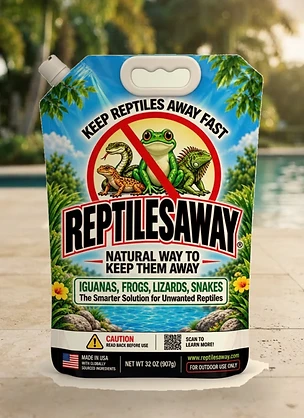
Label mockup shown. Final packaging may vary.
ReptilesAway Powder · 32 oz
1,500 SQ FT · 2–3 WEEKS PER APP$24.99


Label mockup shown. Final packaging may vary.
ReptilesAway Powder · 5-Gallon
30,000 SQ FT · 2–3 WEEKS PER APP$164.99
Three steps. You run them.
Find the travel lines
Walk your Miami Beach property and flag the routes reptiles use — bayfront seawalls, courtyard edges, pool-deck planters, the gaps under a gate.
Lay the band
Shake a three-foot band of powder along those lines. No spray, no fogger, nothing to dry — fine on a courtyard pool deck.
Reapply on schedule
One pass lasts two to three weeks. Reapply after a heavy rain or every couple of weeks through the long iguana season.
Questions about Miami Beach.
The city already removes iguanas. Why would I need a repellent?
The city contractor works public property — parks, rights-of-way, public seawalls. Your seawall, dock, and pool deck are yours to handle, and the city's own page directs residents to private options. A band on your seawall cap and hedge line keeps the next iguana from swimming over from the public wall.
Does the powder work on an open pool deck with no screen enclosure?
Yes. Run the band along the deck edge, the top of any planter, the courtyard perimeter, and a ring around each low light, since that is where geckos and Cuban tree frogs sit at night. Nothing is sprayed and nothing dries, so the deck stays usable, and the band can be refreshed after a storm.
How do you handle a guard-gated island like Sunset Islands or a condo on Belle Isle?
We coordinate access with you or the association, walk the seawall, dock, and landscaped edges, and send a per-visit quote with no annual contract. On a seawalled island, neighbors treating together works better than one lot alone, because the untreated wall next door is where iguanas come ashore.
Take back your Miami Beach yard.
From the Venetian Islands to South Beach, the fix is the same: a granular line where the reptiles travel. Run it yourself, or let our crew handle the whole thing.