
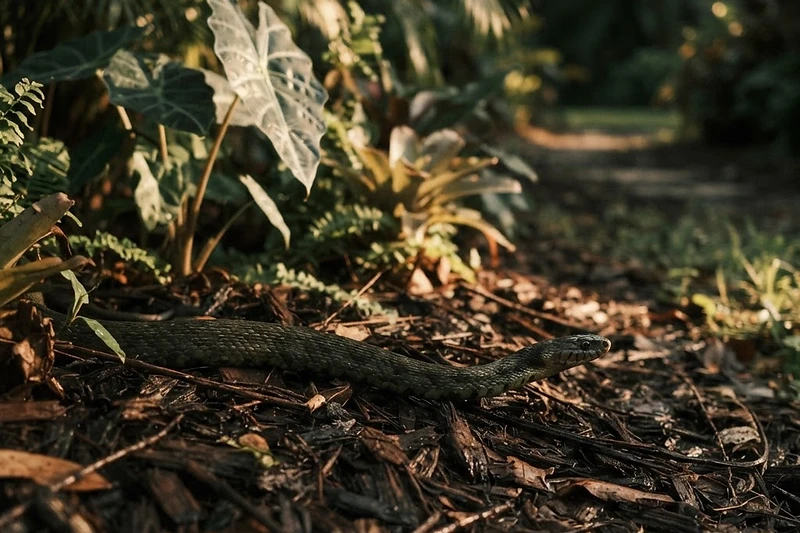
What attracts snakes to a yard
Snakes are attracted to a yard by food, water, and shelter — specifically the rodents, insects, frogs, and lizards that live in the yard's ground cover. A yard with dense mulch, tall grass, woodpiles, stacked lumber, or thick ground-cover plants gives snakes and their prey places to hide.
Bird feeders that spill seed attract rodents, which attract snakes. Standing water and birdbaths attract frogs and lizards, which are also snake food. Compost piles, leaf litter, and cluttered storage areas along fence lines all create the kind of cool, dark, humid environment that snakes and their prey prefer. If you remove the habitat that supports the prey, the snakes have less reason to come through.
Do mulch beds attract snakes
Mulch itself does not attract snakes — but mulch beds create the cool, moist, sheltered environment that attracts the rodents, insects, and amphibians snakes eat. So in practice, a yard with extensive mulch beds and dense ground cover will have more prey animals, and therefore more snakes passing through, than a yard with minimal ground cover.
Cypress mulch and cedar mulch are sometimes marketed as snake-repellent mulches, but there is no reliable evidence that any mulch type repels snakes. Rubber mulch does not attract snakes directly, but it provides the same shelter as organic mulch. The issue is not the mulch material — it is the cover and moisture that any mulch provides. Keep mulch beds thin (2 inches or less), raked, and away from the foundation, and you reduce the habitat value.
How to keep snakes out of the yard, garden and beds
To keep snakes out of the yard, garden, and beds, reduce the ground cover that shelters their prey, eliminate standing water, manage clutter, and create an unpleasant perimeter along the edges snakes follow. Keep grass cut short, trim the bottom branches of shrubs so they do not touch the ground, and store firewood and lumber elevated on racks at least a foot off the ground.
Move bird feeders away from the house and clean up spilled seed. Fill gaps under fences and seal cracks in the foundation. Run a granular band along mulch-bed edges, fence lines, and canal banks — the edges snakes follow as travel corridors. One application lasts two to three weeks. The goal is not to harm the snakes — most are non-venomous and beneficial — but to make the edges they travel unpleasant enough that they stay in the cover rather than crossing onto patios and into pool cages.
Venomous snakes in South Florida and how to tell
South Florida has several venomous snake species, but the ones most relevant to residential yards are the eastern diamondback rattlesnake, the pygmy rattlesnake, the cottonmouth (water moccasin), and the coral snake. Rattlesnakes have a heavy body, a broad triangular head, and a rattle on the tail (though pygmy rattlesnakes have a small rattle that can be hard to hear). Cottonmouths are dark, heavy-bodied water snakes found near canals and ponds.
The coral snake has distinctive red, yellow, and black bands — remember the rhyme about red touching yellow — but do not attempt to identify a snake by color alone. FWC and UF/IFAS both publish identification guides with photos. If you are unsure whether a snake is venomous, treat it as if it is, keep your distance, and do not try to handle or harm it. Call a licensed wildlife removal professional.
What to do if you find a snake — and when to call a pro
If you find a snake in your yard, stay calm, keep children and pets indoors, and give the snake space to leave on its own — most yard snakes are non-venomous and will move away within minutes. Do not try to catch, harm, or relocate the snake yourself; this is how most snake bites happen.
If the snake is in your house, garage, or pool cage and will not leave, or if you believe it may be venomous, call a licensed wildlife removal professional. FWC maintains a list of permitted wildlife trappers by county on its website. If someone is bitten, call 911 immediately, keep the person calm and still, and remove rings and tight clothing near the bite in case of swelling. Do not cut the wound, apply a tourniquet, or try to suck out the venom — those methods do more harm than good.
Does granular snake repellent powder work
A granular snake repellent can work as part of a broader strategy, but no repellent alone solves a snake problem. A granular band along mulch-bed edges, fence lines, and canal banks makes those travel corridors unpleasant for snakes, which encourages them to stay in the surrounding cover rather than crossing into patios, pool cages, or play areas.
But if the yard still has the habitat that attracts rodents and insects — tall grass, thick mulch, woodpiles, spilled bird seed — the prey remains, and snakes will still pass through. The repellent works best when combined with habitat reduction: cut the grass, thin the mulch, elevate the firewood, and then run the band along the edges where snakes travel. One application lasts two to three weeks.
What does NOT work (mothballs, sulfur, ultrasonic)
Mothballs do not repel snakes — they are a chemical pesticide, illegal for outdoor snake use, and toxic to pets and children if ingested. Sulfur products are widely sold as snake repellent, but studies have not shown reliable, lasting effectiveness; snakes may avoid a freshly applied sulfur band initially but do not stay away.
Ultrasonic and sound-emitter devices have no demonstrated effect on snakes; snakes detect ground vibration, not airborne sound in the range these devices produce, and the devices do not change snake behavior. A one-and-done treatment of any kind does not work, because snakes return as long as the habitat that supports their prey remains. No single product, device, or spray solves a snake problem on its own.
About the powder
ReptilesAway is a granular powder — not a spray — that you shake along mulch-bed edges, fence lines, and canal banks where snakes travel. It is formulated as an EPA FIFRA 25(b) minimum-risk pesticide — made only from ingredients on the EPA's minimum-risk list, so it is exempt from federal registration.
The 32 oz bag ($24.99) covers about 1,500 sq ft; the 5-gallon bucket ($164.99) covers about 30,000 sq ft. One application lasts two to three weeks. The five ingredients — sodium chloride, citric acid, lemongrass oil, peppermint oil, and garlic oil — are printed on every bag. Made in Fort Lauderdale, Florida, with a 30-day money-back guarantee. For local treatment in Miami-Dade, Broward, or Palm Beach, call 1-833-8REPTILES (1-833-873-7845) for a quote — no contracts.
Made with food-grade and botanical ingredients. As with any product, keep pets from eating it directly and check the ingredient list if your pet has known sensitivities to any of them.
To keep snakes off your property, lay a granular band along the travel routes described above. The 32 oz bag covers 1,500 sq ft — enough for a typical yard perimeter. For a full perimeter or a large lot, the 5-gallon bucket covers 30,000 sq ft. See our application guide for the three-step method.
Common questions
Does mulch attract snakes?
Mulch itself does not attract snakes, but mulch beds create the cool, moist, sheltered environment that attracts rodents, insects, and amphibians — the prey snakes eat. No mulch type, including cedar or cypress, reliably repels snakes. Keep mulch thin (2 inches or less), raked, and away from the foundation to reduce habitat value.
How do I keep snakes out of my yard?
Keep grass short, trim shrubs off the ground, store firewood elevated, move bird feeders away from the house, fill gaps under fences, and run a granular band along mulch-bed edges and fence lines. Remove the habitat that supports their prey and snakes have less reason to come through. One application lasts two to three weeks.
Are the snakes in my South Florida yard venomous?
Most South Florida yard snakes are non-venomous, but the region does have venomous species including rattlesnakes, cottonmouths, and coral snakes. If you are unsure, keep your distance and do not handle the snake. FWC and UF/IFAS publish identification guides with photos to help you confirm what you are seeing.
Does granular snake repellent work?
A granular band can help keep snakes off patios and out of pool cages when combined with habitat reduction. It makes travel edges unpleasant so snakes stay in the cover. But no repellent alone solves the problem if the yard still attracts the rodents and insects snakes eat. Cut the grass, thin the mulch, then band the edges.
What should I do if I find a snake in my yard?
Stay calm, keep children and pets indoors, and give the snake space to leave. Do not try to catch or harm it. If it is inside or will not leave, or if you believe it may be venomous, call a licensed wildlife removal professional. FWC lists permitted trappers by county on its website. If someone is bitten, call 911.