

Wellington is an inland problem, not a seawall problem
Wellington sits against the Everglades levee, and nearly every neighborhood in the village is built around water the Acme Improvement District pumps through its canal network. Olympia, Versailles, Grand Isles, Black Diamond, Castellina, Buena Vida, and the eleven lake-named villages of the Isles at Wellington are gated HOA communities on retention lakes. Greenview Shores, Pinewood Grove, Sugar Pond Manor, and Wellington's Edge are older non-gated streets on the same lake system, with Lake Wellington — 150 acres dug in the original 1970s plan — in the middle of it. Screened pools are standard.
That combination — lakes, canals, pools, and night lighting — makes cane toads and Cuban tree frogs the dominant call from Wellington, not seawall iguanas. Toads breed in the lakes and Acme canals, come up after rain, and sit on pool decks, under landscape lights, and by the dog's water bowl. Cane toads are toxic to dogs; in neighboring Loxahatchee a golden retriever collapsed after mouthing one, and the trapper who responded advised replacing mulch with rock and screening the perimeter. Cuban tree frogs work the lit lanai screens and pump housings.
Snakes are the second issue, and Wellington is usually the first community named when Palm Beach County news covers snake sightings rising after heavy rain — pygmy and eastern diamondback rattlesnakes, coral snakes, and cottonmouths pushed out of flooded ground. The Wellington Environmental Preserve, Peaceful Waters Sanctuary, and the marsh beyond the levee are the source; the mulch beds, wood piles, and paddock edges of the equestrian estates are where they end up.
The equestrian side
Palm Beach Point, Saddle Trail Park, the Aero Club, Southfields, Grand Prix Village, Mallet Hill, and Equestrian Club Estates are multi-acre lots with barns, wash racks, feed rooms, and pasture drainage ditches. Feed attracts rodents, rodents attract snakes, and the wet edges of a paddock breed toads. Iguanas do show up here too, on the Acme canal banks and lake shores, but they are third on the list. Binks Forest's golf frontage and the larger Greenview Shores lakes have the same canal-bank iguanas at a smaller scale.
Where to lay the band in Wellington
Lake and pool homes (Olympia, Isles at Wellington, Greenview Shores): the outside footer of the pool cage, the lake-facing hedge, and a ring around every low landscape light and the pool-equipment pad. Equestrian estates: the barn aisle thresholds, the feed-room door, the base of the wash rack, the fence line along any ditch or canal, and the mulch beds against the house. Preserve-edge lots: the fence line facing the wetland and the wood pile.
Wellington is about 50 miles northwest of our Fort Lauderdale base, and an equestrian property with a barn and paddock perimeter is the clearest case for the 5-gal bucket we see anywhere in Palm Beach County. Farm managers can book a walk-through for a per-visit quote during show season.
A barrier you control, from five ingredients you can read.
ReptilesAway is a granular powder, not a spray, made from five ingredients — sodium chloride, citric acid, lemongrass oil, peppermint oil, and garlic oil — and formulated as an EPA FIFRA 25(b) minimum-risk pesticide — made only from ingredients on the EPA's minimum-risk list, so it is exempt from federal registration. One application lasts 2–3 weeks. The 32 oz bag is $24.99 and covers 1,500 sq ft; the 5-gal bucket is $164.99 and covers 30,000 sq ft. Made with food-grade and botanical ingredients. As with any product, keep pets from eating it directly and check the ingredient list if your pet has known sensitivities to any of them. Local treatment is priced by quote with no contracts — call 1-833-8REPTILES (1-833-873-7845).
See how it works- Sodium chloride01
- Citric acid02
- Lemongrass oil03
- Peppermint oil04
- Garlic oil05
Buy what you need.
Free shipping on orders of $100 or more. Flat $8.95 under that.

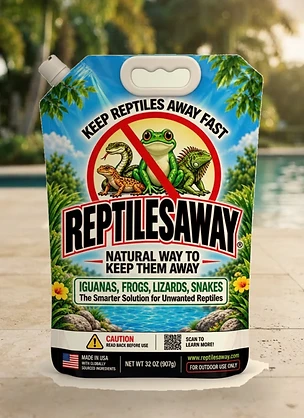
Label mockup shown. Final packaging may vary.
ReptilesAway Powder · 32 oz
1,500 SQ FT · 2–3 WEEKS PER APP$24.99


Label mockup shown. Final packaging may vary.
ReptilesAway Powder · 5-Gallon
30,000 SQ FT · 2–3 WEEKS PER APP$164.99
Three steps. You run them.
Find the travel lines
Walk your Wellington property and flag the routes reptiles use — canal banks, foundation lines, mulch beds, the gaps under a fence.
Lay the band
Shake a three-foot band of powder along those lines. No spray, no fogger, nothing to dry — fine around the barn and paddock.
Reapply on schedule
One pass lasts two to three weeks. Reapply after a heavy rain or every couple of weeks through the long season.
Questions about Wellington.
Can the powder be used around horses and barns in Palm Beach Point or Saddle Trail?
It goes down as dry granules along thresholds, fence lines, and the wash-rack base, not in stalls or feed. It is made with food-grade and botanical ingredients; keep animals from eating it directly and check the five ingredients if a horse or barn dog has known sensitivities to any of them.
We see snakes in the mulch after storms. Is a repellent the right tool?
For keeping them from settling in beds and along the house, yes — treat the mulch beds, wood piles, and the fence line facing the preserve. It is not a removal product. If you find a rattlesnake, cottonmouth, or coral snake in the open, keep dogs and children away and call a licensed trapper.
How often do I reapply on a lake lot in the Isles at Wellington during wet season?
Plan on every two weeks from June through October, and refresh the ring around lights and the pool footer after any storm that floods the lake bank, since that is when cane toads come up in numbers. In the dry season most Wellington owners stretch to three weeks.
Take back your Wellington yard.
From the equestrian estates to the lake communities, the fix is the same: a granular line where the reptiles travel. Run it yourself, or let our crew handle the whole thing.