
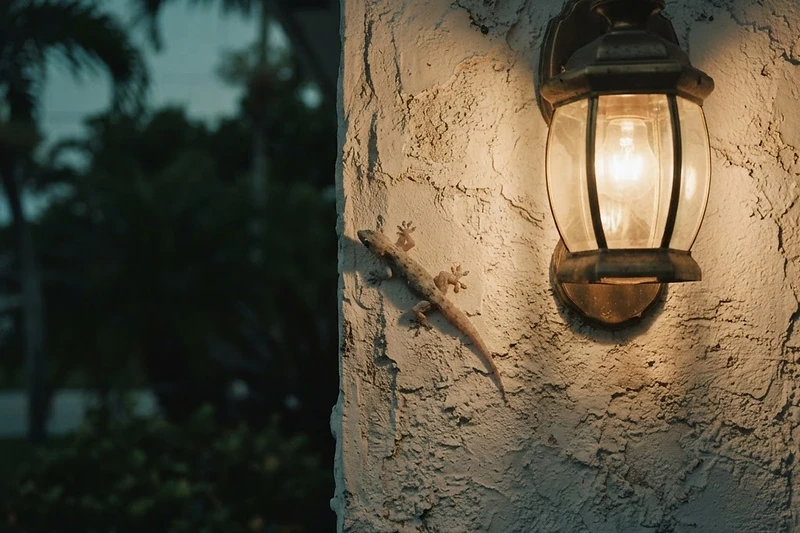
Geckos and anoles come to your house at night for one reason: the insects drawn to your lights. Switch to warmer, motion-activated fixtures and lay a granular band along the walls and thresholds they use to reach those lights, and the lizards move on within a couple of weeks.
It's the light, not the house
If you have geckos on your porch lights and anoles on your stucco walls at night, the house itself isn't the attractant. The lights are. A lit porch light, a bright window, or a floodlight on the garage pulls in moths, beetles, and flying insects — and the lizards follow the food.
It's a simple chain: light draws insects, insects draw lizards. Break any link in that chain and the lizards have less reason to be there. Break the light link and the insects leave; break the route link and the lizards can't reach the insects. Do both and the problem clears up fast.
Geckos vs. anoles — what's the difference?
They're both small lizards, and homeowners in South Florida use the names interchangeably, but they behave a little differently at night:
Geckos
Geckos are the soft-bodied lizards that cling to vertical surfaces — porch lights, window frames, the upper corners of screened enclosures. They're active at night and they're there because the light is. A gecko can hang on a porch light fixture for hours, picking off moths. They're quiet and useful in the wild, but a colony on a screened patio leaves droppings and shed skin on the furniture. See our geckos page for the full breakdown.
Anoles
Anoles are the quick, small lizards that dart across stucco walls and patios. The brown anole and the green anole are both common in South Florida. They're more active during the day, but they stack up around exterior lights at dusk because that's where the insect activity is. A few anoles on the wall is normal; dozens around every light fixture is a sign the food source is too rich. Our lizards page covers them in detail.
How to break the pattern
Two steps, done together, clear most nighttime lizard problems within a couple of weeks.
Step 1: Change the lights
The single most effective change is to reduce the insect draw. A few things that work:
- Switch to warm or yellow bulbs. Insects are drawn to cool, blue-white light. A warm amber or yellow LED attracts far fewer bugs, which means fewer lizards.
- Use motion-sensor fixtures. A light that's only on when something moves doesn't give insects hours to gather. The lizards learn there's no steady food source and stop coming.
- Turn off unnecessary lights. A porch light left on all night is a beacon. If you don't need it, a timer or a motion sensor solves it.
You don't have to go dark — you just have to stop running a steady bug buffet from dusk to bedtime.
Step 2: Band the travel routes
Lizards don't teleport onto your porch light. They climb up a wall, a screen, or a post to get there. That route is the travel line, and a granular band across it makes the lizards avoid the climb.
Shake the powder along the base of the wall under the worst light fixtures, the window frames where geckos gather, and the thresholds of screen enclosures and side doors. The 32 oz bag is the right size for a typical home's light-fixture perimeter. One application lasts two to three weeks — keep it fresh through the warm months when insect activity is highest.
Why they keep coming back
Lizards are territorial and habitual. A gecko that's found a good porch light will return to it night after night, and other geckos will move into the same spot once it's vacated. That's why a one-time clearing doesn't last — you need to keep the lights changed and the band maintained for a couple of weeks to break the habit across the whole local population.
Once the food source is reduced and the routes are banded, the lizards shift to easier hunting grounds. They don't leave the neighborhood — they just stop using your lights as a feeding station.
The screened-enclosure problem
Pool cages and screened patios are a special case. The lights inside the enclosure draw insects, the insects draw geckos, and the geckos leave droppings on the screens and the furniture. The threshold where the screen meets the concrete is the travel route — band it, and the geckos stop climbing in. If you're in Miami or anywhere with a pool cage, the threshold band is the highest-leverage thing you can do.
Around pets
If you have pets that roam the perimeter at night, you want to know what's in the powder you're laying along the walls. Made with food-grade and botanical ingredients. As with any product, keep pets from eating it directly and check the ingredient list if your pet has known sensitivities to any of them. Five ingredients, listed on every bag: sodium chloride, citric acid, lemongrass oil, peppermint oil, garlic oil.
The bottom line
Geckos and anoles at night are a light-and-route problem, not a lizard problem. Reduce the insect draw with warmer bulbs and motion sensors, band the walls and thresholds the lizards use to reach the lights, and maintain it for two to three weeks. The lizards reroute to easier pickings and your porch lights go back to being porch lights.
Ready to lay the band? Shop the powder and start this weekend. Or book a treatment and our crew will handle the whole perimeter.