
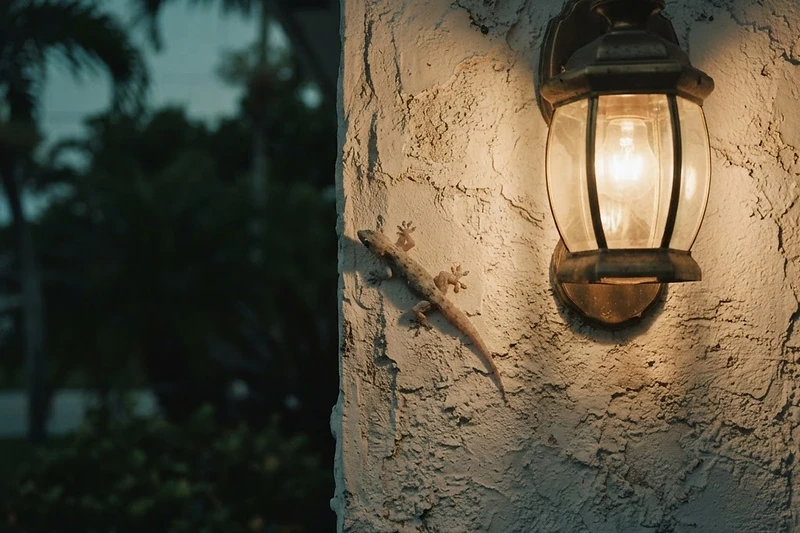
Why geckos gather on walls and windows at night
Geckos gather on walls and windows at night because exterior lights draw the flying insects they eat, and the geckos position themselves on the nearest surface to the light to feed. A porch light, a floodlight, or light shining through a window creates a feeding zone where moths, beetles, and other insects cluster.
Geckos are nocturnal and have specialized toe pads that let them cling to smooth vertical surfaces — stucco, glass, screen — so they can reach insects that other lizards cannot. The warmer and more humid the night, the more active the insects and the geckos. The light, not the wall or the window, is the attraction — turn off the light, the insects disperse, and the geckos have no reason to stay.
How geckos get into a house or garage
Geckos get into a house or garage through gaps under doors, torn screens, gaps around window frames and utility lines, weep holes in brick, and doors left open at night when lights are on. House geckos are small and flexible — they can fit through a gap the width of a pencil — so even small cracks are enough.
They are drawn inside by the same thing that draws them to exterior walls: light that attracts insects. A garage with the door open and a light on at night is an open invitation. Once inside, geckos are hard to catch because they are fast, they cling to ceilings and walls, and they hide behind furniture, appliances, and stored items. The best approach is prevention: seal gaps with weatherstripping, repair torn screens, and keep doors and windows closed or screened when lights are on after dark.
Are house geckos harmful
House geckos are not harmful to humans or pets. They are not venomous, they do not carry diseases that transmit to people, and they are too small to bite through skin. They eat insects — moths, roaches, ants, and spiders — so in many settings they are beneficial.
The problems they cause are nuisance problems: droppings on walls, windowsills, and floors, shed skin in corners, and the noise some species make (a chirping or barking call, particularly during mating season). If you have a heavy gecko population around a screened patio or inside a garage, the mess and the noise are the issue, not a health risk. If a gecko is inside your house, it is not dangerous, but it is also not something you want to leave, because it will leave droppings and eventually die if it cannot find enough food or water.
Gecko droppings on walls and screens
Gecko droppings are the main complaint people have about geckos on walls and screens. The droppings are small, dark, and often have a white tip (uric acid), and they accumulate on window sills, patios, and the base of walls where geckos congregate. Over time, the droppings can stain painted surfaces and screens.
Geckos also shed their skin periodically, leaving translucent fragments in corners and along window frames. To manage the mess, clean surfaces regularly with a mild soap solution, and address the root cause — the lights that are drawing the geckos. Reducing nighttime lighting and running a granular band along the base of walls and window frames reduces the number of geckos on the surfaces, which means fewer droppings to clean.
Lighting changes that actually reduce them
Lighting changes are the single most effective step for reducing geckos on walls and windows, because the geckos are there for the insects, and the insects are there for the light. Switch cool-white and daylight LED bulbs to warm or yellow LEDs (2700K or lower), which attract significantly fewer flying insects.
Put porch and landscape lights on a timer or motion sensor so they are not on all night. Turn off non-essential lights after 10 p.m. Close blinds or curtains on lit windows that face the yard or patio. If you have a screened enclosure with a light, use it sparingly and switch the bulb to warm LED. Within a week or two of reducing the light, the insect supply drops, and the geckos have less reason to gather — this is the change that produces the most visible result.
What does NOT work
Ultrasonic and sound-emitter devices do not repel geckos — geckos do not hear in the range these devices target, and there is no evidence they change gecko behavior. General-purpose animal repellent sprays are not formulated for geckos and have no demonstrated effect. Glue boards and sticky traps catch geckos but also catch beneficial insects, tree frogs, and anoles, and they are inhumane.
Mothballs are illegal for outdoor use and toxic to pets and children. A one-and-done spray or device does not work, because geckos return as long as the light, insects, and hiding spots that drew them remain. No single product solves a gecko problem by itself — reducing the lighting, sealing gaps, and maintaining a perimeter is the only approach that lasts.
About the powder
ReptilesAway is a granular powder — not a spray — that you shake along the base of walls, window frames, and screen-enclosure thresholds where geckos travel to reach the lights that draw insects. It is formulated as an EPA FIFRA 25(b) minimum-risk pesticide — made only from ingredients on the EPA's minimum-risk list, so it is exempt from federal registration.
The 32 oz bag ($24.99) covers about 1,500 sq ft; the 5-gallon bucket ($164.99) covers about 30,000 sq ft. One application lasts two to three weeks. The five ingredients — sodium chloride, citric acid, lemongrass oil, peppermint oil, and garlic oil — are printed on every bag. Made in Fort Lauderdale, Florida, with a 30-day money-back guarantee. For local treatment in Miami-Dade, Broward, or Palm Beach, call 1-833-8REPTILES (1-833-873-7845) for a quote — no contracts.
Made with food-grade and botanical ingredients. As with any product, keep pets from eating it directly and check the ingredient list if your pet has known sensitivities to any of them.
To keep geckos off your property, lay a granular band along the travel routes described above. The 32 oz bag covers 1,500 sq ft — enough for a typical yard perimeter. For a full perimeter or a large lot, the 5-gallon bucket covers 30,000 sq ft. See our application guide for the three-step method.
Common questions
Why do geckos gather on my walls at night?
Geckos gather on lit walls because exterior lights draw the flying insects they eat. Geckos have specialized toe pads that let them cling to smooth vertical surfaces. Turn off the light, the insects disperse, and the geckos have no reason to stay. The light, not the wall, is the attraction.
How do geckos get into my house?
Geckos enter through gaps under doors, torn screens, gaps around window frames and utility lines, and doors left open at night when lights are on. They can fit through very small gaps. Seal gaps with weatherstripping and repair screens to prevent entry. Keep doors closed when lights are on after dark.
Are house geckos harmful?
No. House geckos are not venomous, do not carry diseases that transmit to people, and are too small to bite through skin. They eat insects like moths, roaches, and ants. The main complaints are droppings on walls and windowsills, shed skin in corners, and chirping noises during mating season.
How do I get rid of geckos in my garage?
Keep the garage door closed when lights are on at night, switch bulbs to warm LED, reduce clutter, and run a granular band along the base of the garage walls and door. The combination of lighting changes and a perimeter band is what produces lasting results. One application lasts two to three weeks.
Does gecko repellent work?
Ultrasonic devices, mothballs, and general animal repellent sprays have no demonstrated effect on geckos. What works is reducing the lighting that draws insects, sealing gaps to prevent entry, and maintaining a granular band along the base of walls and window frames. No single product solves it alone.