
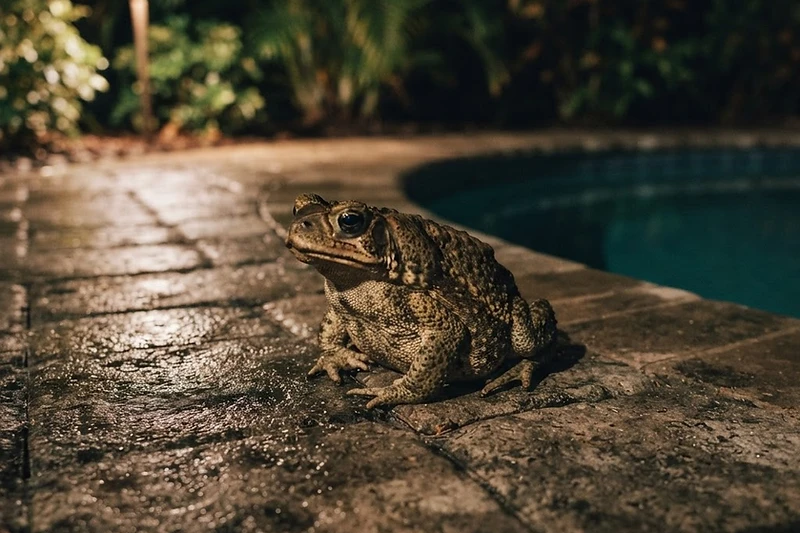
Cane toads secrete a toxin that's dangerous to dogs that lick or mouth them. The safest approach is to keep them off the property in the first place: remove the moisture and food sources that attract them, and lay a granular band along the damp edges, AC pads, downspouts, and foundation line where they travel.
What are cane toads?
Cane toads — sometimes called bufo toads — are large, invasive toads established across South Florida. They're bigger than the native southern toad, with a prominent ridge over each eye and a large parotoid gland behind each eye that secretes a milky toxin when the toad feels threatened. They're active at night, especially after rain, and they congregate around moisture and outdoor lights where insects gather. UF/IFAS maintains detailed cane toad identification and management guidance at the UF/IFAS Cane Toad EDIS publication and the UF/IFAS "Ask IFAS" cane toad resource.
They've been in Florida for decades and they're part of the landscape now. You won't eliminate them from the region — but you can make your yard the part of their route they skip. For the full species guide, see our toads page.
Are cane toads poisonous to dogs?
Yes. Cane toad toxin — a mix of compounds called bufotoxins — is dangerous to dogs that lick, mouth, or pick up a toad. The toxin is secreted from the parotoid glands behind the toad's eyes when the animal is threatened, and a dog absorbs it rapidly through the gums and mouth lining. It acts on the heart and nervous system, and a sufficient dose can be fatal within minutes to hours. Small dogs are at higher risk because the toxin concentration relative to body weight is greater. UF/IFAS classifies the cane toad as a threat to pets and wildlife and recommends that any dog that has contacted a cane toad be taken to a veterinarian immediately.
This is a real veterinary concern in South Florida, especially during the warm, wet months when cane toads are most active. The best protection is keeping the toads off the parts of the yard where the dog roams — the lawn, the pool deck, and the areas near the back door.
Symptoms of toad poisoning in dogs
If your dog has mouthed a cane toad, watch for these signs, which can progress quickly:
- Profuse, thick drooling and frothing at the mouth
- Pawing at the mouth or shaking the head
- Bright red, inflamed gums and tongue
- Vomiting
- Difficulty breathing or rapid breathing
- Staggering, weakness, or collapse
- Seizures or muscle tremors
- Abnormal heart rhythm — very fast or very irregular
Signs can appear within minutes of contact. The faster you act, the better the outcome — early rinsing and an immediate vet call make a real difference.
Where cane toads show up
Cane toads are drawn to moisture and insects. The spots they favor on a South Florida property:
- AC pads and condensate lines. The drip keeps the ground damp and the pad cool — ideal daytime shelter.
- Downspouts and the damp mulch beneath them. After rain, these stay wet for days and draw insects.
- Pool decks and pool-cage thresholds. Toads come up from the landscaping to the damp deck edge.
- Pet-food bowls left outside. Cane toads will eat dog and cat food left on the ground overnight.
- Outdoor lights. The lights draw insects, and the toads come for the insects.
If you're in Coral Springs or anywhere with preserve-adjacent lots and canal-edge cover, you've probably seen them on the patio after a summer rain.
How to keep them off your lawn and pool deck
Two things, done together: remove the attractants, and band the travel routes.
Remove the moisture and food sources
- Pick up pet-food bowls at night. This is the single easiest change. Leftover kibble is a cane toad magnet.
- Fix the AC condensate. If the pad is a swamp, redirect the drip or let it drain to a drier area.
- Manage the downspout mulch. Don't let mulch stay sodden for days after rain.
- Switch outdoor lights to warm or yellow bulbs and use motion sensors. Fewer insects means fewer toads.
Lay the band
Shake the granular powder along the damp edges, around AC pads and downspouts, and along the foundation line — especially the stretch between the landscaping and the pool deck or back door. You're banding the routes toads use to come up from the cover and onto the living areas. The 32 oz bag covers a typical home's perimeter; a large lot may need the 5-gallon bucket.
One application lasts two to three weeks. Through the wet season — late spring through fall — reapply after a heavy rain or every couple of weeks. The toads avoid the banded routes and stick to the unbanded cover, which keeps them off the lawn and deck where the dog is.
An honest note: no repellent is scientifically proven against cane toads
We make a repellent, and we want to be straight with you: no repellent product — ours included — has been scientifically proven to repel cane toads. There is no peer-reviewed study showing that granular botanical repellents keep cane toads off a property. If a product claims to be "proven" or "guaranteed" against cane toads, that claim is not supported by scientific evidence.
What ReptilesAway is, and what we're honest about: it's a granular botanical powder you lay as a perimeter band along the routes toads use to travel from cover onto the lawn and pool deck. The idea is to make the travel line unpleasant so toads reroute through the landscaping rather than crossing into the area where dogs roam. It is one part of a strategy that starts with removing the moisture and food that attract toads in the first place — pet-food bowls, AC drips, sodden mulch — because no perimeter band compensates for a yard that's a toad buffet.
The part a homeowner can control is the habitat: pick up pet food at night, fix the AC drip, manage the downspout mulch, switch to warmer motion-sensor lights. Then band the perimeter. That's the honest, layered approach — and it's what we recommend whether you use our product or someone else's.
Around pets
If you have dogs, the question is always whether the powder itself is safe. Made with food-grade and botanical ingredients. As with any product, keep pets from eating it directly and check the ingredient list if your pet has known sensitivities to any of them. Five ingredients are listed on every bag: sodium chloride, citric acid, lemongrass oil, peppermint oil, garlic oil. Applied as a band along the foundation and damp edges — not in the middle of the lawn where the dog rolls — it stays where you put it.
What to do if your dog mouths a cane toad
If you suspect your dog has licked or mouthed a cane toad, act immediately. UF/IFAS guidance for pet owners recommends these first-aid steps while you head to the vet:
- Wipe the gums outward with a wet cloth. Use a damp washcloth or towel and wipe the inside of the dog's mouth — gums, tongue, and cheeks — wiping outward so toxin is removed rather than pushed further in. Rinse the cloth and repeat several times.
- Rinse the mouth sideways so water doesn't get swallowed. Use a hose on a gentle stream or a squirt bottle, directing the water across the mouth and out the side — not down the throat, which can push toxin into the stomach or cause choking.
- Go to the vet immediately. Even if your dog seems to improve after rinsing, the toxin can affect the heart and nervous system. Call ahead so the clinic is ready. Don't wait for symptoms to worsen — early veterinary treatment makes a significant difference.
These steps are drawn from UF/IFAS guidance on cane toads and pet safety. The UF/IFAS "Ask IFAS" cane toad resource includes current recommendations for pet owners, and the UF/IFAS EDIS cane toad publication covers identification, impacts, and management. This is first aid, not a substitute for a veterinarian's care.
The bottom line
Cane toads and dogs are a serious combination in South Florida, but the approach is straightforward: take away the moisture and food that draw the toads, band the routes they use to reach the lawn and pool deck, and keep the band fresh through the wet season. The toads stay in the landscaping and the cover, and the dog's roaming area stays clear.
Ready to lay the band? Shop the powder. Or if you'd rather have the crew handle the whole perimeter — AC pads, downspouts, foundation, pool deck — book a treatment and we'll run it with no contracts.