
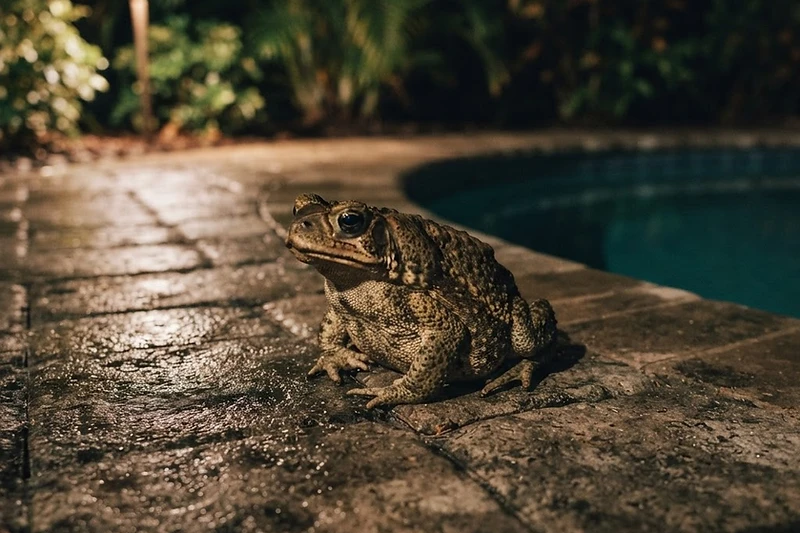
Cane toad vs native southern toad — how to tell them apart
The fastest way to tell a cane toad from a native southern toad is size and the glands behind the eyes. Cane toads are large — adults commonly reach 4 to 6 inches — while southern toads rarely exceed 3 inches. Cane toads have prominent triangular poison glands (parotoid glands) that angle down and backward from behind each eye toward the shoulder.
Southern toads have smaller, kidney-shaped glands that sit high behind the eye and do not angle down. They also have raised crests on top of the head between the eyes, which cane toads lack. UF/IFAS publishes side-by-side identification guides that make the comparison clear — if you are unsure, photograph the toad from above and compare it to those guides rather than handling it.
Are cane toads poisonous to dogs, cats and humans
Yes, cane toads are poisonous to dogs, cats, and humans. They secrete a milky toxin from the parotoid glands behind their eyes when threatened — typically when a dog mouths or picks one up. The toxin affects the heart and nervous system and can be fatal to a dog within 15 to 30 minutes if a large toad is involved.
Cats are less commonly affected because they are less likely to grab a toad, but they are equally vulnerable to the toxin. Humans can experience skin and eye irritation from handling a toad, and ingestion of the toxin is dangerous. The key point is that cane toads are not safe to pick up, and pets should not corner or chase them. Even a dead cane toad can still release toxin, so picking up a carcass with bare hands is not advisable.
What to do in the first minutes if your dog mouths a toad
If your dog mouths a cane toad, immediately wipe the inside of the mouth and gums with a wet cloth, rinsing the cloth between wipes, and call your veterinarian or an animal emergency clinic right away — do not wait for symptoms. Use a hose to gently flush the mouth from the side, letting water drain back out rather than down the throat.
Watch for drooling, head-shaking, bright red gums, stiffness, tremors, seizures, or collapse — all signs of serious toxicity that need immediate veterinary care. Do not try to make the dog vomit. If it is after hours, go to the nearest emergency animal hospital. The faster you remove toxin from the mouth tissue and reach a vet, the better the outcome.
Why cane toads are in your yard
Cane toads come into a yard for three things: moisture, insects, and shelter. They are most active at night and after rain, when they move from daytime hiding spots toward water and the insects drawn to outdoor lights. A yard with standing water, a dripping AC condensate line, a pool, a pond, or a low spot that stays damp is attractive.
Floodlights and landscape lighting draw moths and beetles, which draw toads. Dense ground cover — thick mulch, lumber, potted plants clustered together, or low shrubs — gives them cool, dark places to hide during the day. Remove or reduce those three things and the yard becomes far less interesting to a toad.
Pool decks, landscape lights and dog bowls
Pool decks are a cane toad hotspot because they combine everything toads want in one place: water, insects around the pool light, and cool damp concrete under the deck or near the equipment pad. Landscape lights that stay on all night create a constant food supply. A dog bowl left with water or food overnight is an open invitation.
To make a pool deck less attractive, turn off non-essential lights after 10 p.m., switch floodlights to warm or yellow LED bulbs (which attract fewer insects than cool-white bulbs), feed pets indoors or pick up bowls before dark, and clear leaves and debris from under the deck and around the equipment pad where toads hide during the day.
How to toad-proof a yard
To toad-proof a yard, eliminate standing water, reduce nighttime lighting, clear daytime hiding spots, and create an unpleasant perimeter along the routes toads use to enter. Fix dripping hoses and AC condensate lines, fill low spots that hold water, and make sure downspouts drain away from the foundation. Store lumber, boards, and pots off the ground.
Run a granular band along damp edges, foundation lines, AC pads, and downspout splash blocks — the routes toads follow from cover to water. Pick up pet food and water bowls before sunset. One application of the band lasts two to three weeks. Consistency matters more than any single treatment: the goal is to make the yard unattractive every night, not just once.
What does NOT work
Mothballs do not repel cane toads — they are a chemical pesticide, illegal to use outdoors for toads, and toxic to pets and children if ingested. Ultrasonic and sound-emitter devices have no demonstrated effect on toads; toads do not hear in the range these devices target and are not deterred by them. Sulfur products marketed for snakes do not repel toads either.
A one-and-done treatment of any kind does not work, because toads return as long as the water, light, and cover that drew them remain. No single product, spray, or device solves a cane toad problem on its own — removing the attractants and maintaining a perimeter is the only approach that produces lasting results.
About the powder
ReptilesAway is a granular powder — not a spray — that you shake along the damp edges, AC pads, downspouts, and foundation lines toads use to reach the lawn and pool deck. It is formulated as an EPA FIFRA 25(b) minimum-risk pesticide — made only from ingredients on the EPA's minimum-risk list, so it is exempt from federal registration.
The 32 oz bag ($24.99) covers about 1,500 sq ft; the 5-gallon bucket ($164.99) covers about 30,000 sq ft. One application lasts two to three weeks. The five ingredients — sodium chloride, citric acid, lemongrass oil, peppermint oil, and garlic oil — are printed on every bag. Made in Fort Lauderdale, Florida, with a 30-day money-back guarantee. For local treatment in Miami-Dade, Broward, or Palm Beach, call 1-833-8REPTILES (1-833-873-7845) for a quote — no contracts.
Made with food-grade and botanical ingredients. As with any product, keep pets from eating it directly and check the ingredient list if your pet has known sensitivities to any of them.
To keep toads off your property, lay a granular band along the travel routes described above. The 32 oz bag covers 1,500 sq ft — enough for a typical yard perimeter. For a full perimeter or a large lot, the 5-gallon bucket covers 30,000 sq ft. See our application guide for the three-step method.
Common questions
Are cane toads poisonous to dogs?
Yes. Cane toads secrete a toxin from glands behind their eyes that is dangerous and potentially fatal to dogs. If a dog mouths or picks up a cane toad, wipe the mouth with a wet cloth and call your veterinarian immediately. Smaller dogs and larger toads carry the highest risk, and symptoms can appear within minutes.
How can I tell a cane toad from a southern toad?
Cane toads are larger (4 to 6 inches) with triangular poison glands that angle down behind each eye toward the shoulder. Southern toads are smaller (under 3 inches) with smaller, kidney-shaped glands and raised crests on top of the head between the eyes. UF/IFAS publishes identification guides with photos to help you confirm.
What should I do if my dog mouths a cane toad?
Immediately wipe the inside of the mouth and gums with a wet cloth, rinse between wipes, and call your veterinarian or an animal emergency clinic. Use a hose to gently flush the mouth from the side. Watch for drooling, red gums, tremors, or collapse. Do not try to make the dog vomit — go to the vet right away.
How do I keep cane toads out of my yard?
Eliminate standing water, reduce nighttime lighting, clear daytime hiding spots like lumber and thick mulch, and pick up pet food bowls before dark. Run a granular band along damp edges, AC pads, and foundation lines where toads travel. Consistency matters more than any single treatment — the yard must be unattractive every night.
Do mothballs or ultrasonic devices repel cane toads?
No. Mothballs are illegal for outdoor toad use and toxic to pets and children. Ultrasonic devices have no demonstrated effect on toads. Sulfur products do not repel toads either. No single product or device solves a cane toad problem — removing attractants and maintaining a perimeter is the only lasting approach.