

Plantation's iguanas live on freshwater, not the coast
Plantation has no seawall on the Intracoastal, but it has the C-12 Plantation Canal — one of the district's primary drainage canals — the North New River Canal along its south edge at historic Lock No. 1, the Holloway Canal on the west side of Plantation Park, and a lake on almost every block of the neighborhoods built after 1978. Green iguanas do exactly what they do on the coast: they sun on the bank, burrow into it, and walk the hedge line to the pool.
The hot spots follow the water. Plantation Isles and Melaleuca Isles are 1959–84 canal-front homes with ocean-access canals behind them and no HOA. Plantation Golf Estates backs onto canals and the Plantation Preserve golf course, which is surrounded by water. Jacaranda Lakes — 1978–95, HOA, several lakes and two canals, and private pools on the majority of lots — is the classic case: lake bank, screened pool, lit lanai. Hawks Landing's manned-gate estate lots are mostly waterfront. Lauderdale West's 55+ villas sit on the same lake system.
The frog-and-toad side of the city
Because nearly every Plantation lake is a retention lake, Cuban tree frogs and cane toads are as common a call here as iguanas. Tree frogs sit on lit lanai screens and windows, pack into pump housings, and get into homes through roof vents; cane toads come up from the lake after rain, sit under landscape lights and by dog bowls, and are toxic to dogs. Plantation Acres — acre-plus lots west of Hiatus Road with bridle paths, an equestrian center, and Volunteer Park's 85 acres of boardwalks and wetland — adds the snake question: mulch beds, wood piles, and paddock edges near the wetland see them move in after heavy rain. Plantation Heritage Park's lake and the Jacaranda Golf Club fairways keep the same animals moving through the middle of the city.
Where to lay the band in Plantation
Lake and canal lots (Jacaranda Lakes, Plantation Isles, Hawks Landing): a continuous band along the top of the bank, the outside footer of the pool cage, the lake-facing hedge, and a ring around each low landscape light and the pool-equipment pad. Golf Estates and Preserve-edge homes: the fairway-side hedge and the fence line. Plantation Acres: barn thresholds, the fence line along any ditch, and the mulch beds against the house.
Plantation is about eight miles west of our Fort Lauderdale base, straight out Broward Boulevard, so it is one of the quickest visits we make. A Jacaranda Lakes pool home is a 32 oz bag; a Plantation Acres lot with a barn and a long fence line is a 5-gal bucket.
A barrier you control, from five ingredients you can read.
ReptilesAway is a granular powder, not a spray, made from five ingredients — sodium chloride, citric acid, lemongrass oil, peppermint oil, and garlic oil — and formulated as an EPA FIFRA 25(b) minimum-risk pesticide — made only from ingredients on the EPA's minimum-risk list, so it is exempt from federal registration. One application lasts 2–3 weeks. The 32 oz bag is $24.99 and covers 1,500 sq ft; the 5-gal bucket is $164.99 and covers 30,000 sq ft. Made with food-grade and botanical ingredients. As with any product, keep pets from eating it directly and check the ingredient list if your pet has known sensitivities to any of them. Local treatment is priced by quote with no contracts — call 1-833-8REPTILES (1-833-873-7845).
See how it works- Sodium chloride01
- Citric acid02
- Lemongrass oil03
- Peppermint oil04
- Garlic oil05
Buy what you need.
Free shipping on orders of $100 or more. Flat $8.95 under that.

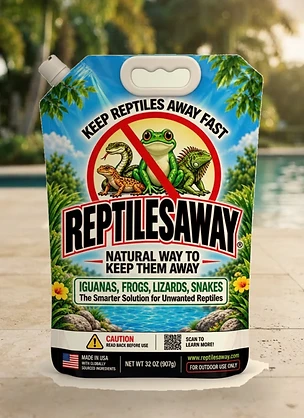
Label mockup shown. Final packaging may vary.
ReptilesAway Powder · 32 oz
1,500 SQ FT · 2–3 WEEKS PER APP$24.99


Label mockup shown. Final packaging may vary.
ReptilesAway Powder · 5-Gallon
30,000 SQ FT · 2–3 WEEKS PER APP$164.99
Three steps. You run them.
Find the travel lines
Walk your Plantation property and flag the routes reptiles use — canal banks, foundation lines, pool-cage edges, the gaps under a gate.
Lay the band
Shake a three-foot band of powder along those lines. No spray, no fogger, nothing to dry — fine around the pool and patio.
Reapply on schedule
One pass lasts two to three weeks. Reapply after a heavy rain or every couple of weeks through the long iguana season.
Questions about Plantation.
Iguanas are eating the hedge along my Jacaranda Lakes lake bank. Where does the band go?
Along the top of the bank where the grass meets the water, at the base of the hedge they are stripping, and along the outside footer of the pool cage. Reapply every two weeks in wet season, because storm runoff on a retention lake washes the bank. Several lake-front neighbors treating together is the most effective pattern.
Cane toads sit on my Plantation Isles patio every night after rain. Is this the right product?
Yes. Ring each low landscape light and the pool-equipment pad, and run the band along the canal bank and the outside footer of the enclosure. Toads are most active May through October, so keep the band fresh then and keep dogs away from any toad you find, since cane toads are toxic to them.
Can you treat an equestrian lot in Plantation Acres?
Yes. We walk the property, mark the barn thresholds, ditch line, wood piles, and mulch beds near the house, and send a per-visit quote with no contract. The powder goes down as dry granules along those edges, not in stalls or feed; keep animals from eating it directly.
Take back your Plantation yard.
From the golf courses to the canal homes, the fix is the same: a granular line where the reptiles travel. Run it yourself, or let our crew handle the whole thing.