

Two different problems, ten minutes apart
Palm Beach Gardens splits cleanly along Prosperity Farms Road. East of it are the Intracoastal pockets — Intracoastal Park, Maheu Estates, Paradise Port, Pirates Cove, Snook Hole, The Cove, Cypress Island — plus the Frenchman's Creek yacht basin and the townhomes at Marina Gardens. These are 1960s–70s canal-front ranch homes and newer waterfront rebuilds with seawalls, docks, and the Earman River (the C-17 Canal) running behind them. That is green iguana territory: burrows behind the seawall cap, droppings on the dock and pool deck, and a stripped hibiscus hedge every spring.
West of Prosperity Farms it is a different animal. PGA National, BallenIsles, Mirasol, Old Palm, Frenchman's Reserve, Eastpointe, Evergrene, and Alton are gated golf and lake communities where nearly every home has a screened pool and a retention lake within a short walk. Those lakes are toad and frog factories. In March 2019, Mirabella at Mirasol made national news when thousands of juvenile cane toads came up out of the community lakes and covered pool decks, patios, and driveways, clogging pool filters. Cane toads are toxic to dogs. Cuban tree frogs come out of the same lakes, sit on lit windows and lanai screens, leave egg masses in pools, and pack into pump housings and transformer boxes.
Farther west, past Sandhill Crane Access Park on PGA Boulevard, the city backs onto the Loxahatchee Slough Natural Area and the C-18 Canal — twenty-plus square miles of Northern Everglades habitat. Homes along that edge, and the acreage lots in Palm Beach Country Estates and Caloosa, see snakes move up into mulch beds and garage aprons after heavy rain.
Where to lay the band in Palm Beach Gardens
Canal-front homes off Prosperity Farms: run the powder along the top of the seawall, the dock landing, and the grass strip between the water and the house. Add a band along the base of any hedge iguanas have been eating. If you border Frenchman's Forest Natural Area, treat the fence line on that side too.
Golf and lake communities: the band goes along the outside footer of the pool cage, around the lake-facing hedge, and in a ring around every ground-level landscape light, pond pump, and pool-equipment pad — that is where cane toads and tree frogs sit after dark. After a wet-season storm or a mass toad emergence, refresh it. Evergrene and Alton lakefront lots should treat the lake bank as well, since iguanas work those banks.
Palm Beach Gardens is about 55 miles north of our Fort Lauderdale base, so we schedule it with Jupiter and North Palm Beach visits. HOA boards in PGA National or Mirasol that want a common-area lake bank treated can request a walk-through and a per-visit quote; there is no annual plan to sign.
A barrier you control, from five ingredients you can read.
ReptilesAway is a granular powder, not a spray, made from five ingredients — sodium chloride, citric acid, lemongrass oil, peppermint oil, and garlic oil — and formulated as an EPA FIFRA 25(b) minimum-risk pesticide — made only from ingredients on the EPA's minimum-risk list, so it is exempt from federal registration. One application lasts 2–3 weeks. The 32 oz bag is $24.99 and covers 1,500 sq ft; the 5-gal bucket is $164.99 and covers 30,000 sq ft. Made with food-grade and botanical ingredients. As with any product, keep pets from eating it directly and check the ingredient list if your pet has known sensitivities to any of them. Local treatment is priced by quote with no contracts — call 1-833-8REPTILES (1-833-873-7845).
See how it works- Sodium chloride01
- Citric acid02
- Lemongrass oil03
- Peppermint oil04
- Garlic oil05
Buy what you need.
Free shipping on orders of $100 or more. Flat $8.95 under that.

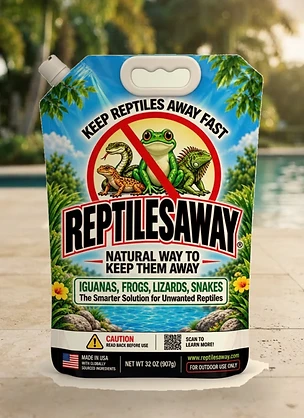
Label mockup shown. Final packaging may vary.
ReptilesAway Powder · 32 oz
1,500 SQ FT · 2–3 WEEKS PER APP$24.99


Label mockup shown. Final packaging may vary.
ReptilesAway Powder · 5-Gallon
30,000 SQ FT · 2–3 WEEKS PER APP$164.99
Three steps. You run them.
Find the travel lines
Walk your Palm Beach Gardens property and flag the routes reptiles use — lakeshores, foundation lines, pool-cage edges, the gaps under a gate.
Lay the band
Shake a three-foot band of powder along those lines. No spray, no fogger, nothing to dry — fine around the pool and patio.
Reapply on schedule
One pass lasts two to three weeks. Reapply after a heavy rain or every couple of weeks through the long iguana season.
Questions about Palm Beach Gardens.
My Mirasol pool is full of baby toads after every rain. Will a repellent help?
It helps most when it is already down before the emergence. Keep a continuous band along the pool-cage footer and the lake-side hedge through wet season, and ring the landscape lighting the toads gather under. Skim the pool and check the skimmer basket, since cane toads are toxic to dogs.
Iguanas are burrowing behind my seawall off Prosperity Farms Road. Where does the powder go?
Along the dry seawall cap, the dock landing, and the grass strip between the water and the house — those are the travel lines, and a burrowed seawall is worth checking with a marine contractor. Reapply every two weeks in summer, since tidal splash and daily storms shorten the interval on the Earman River.
Is it safe to put down inside a screened lanai where my dog goes out?
The powder is made with food-grade and botanical ingredients and goes down as dry granules along edges, not across the whole floor. Keep pets from eating it directly and check the five ingredients if your dog has known sensitivities. Most owners run the band on the outside footer of the cage instead.
Take back your Palm Beach Gardens yard.
From Prosperity Farms to Mirasol, the fix is the same: a granular line where the reptiles travel. Run it yourself, or let our crew handle the whole thing.