

The Lagoon side: iguanas on the seawalls
West Palm Beach's east edge is the Lake Worth Lagoon, and the neighborhoods that line it — El Cid, SoSo, South Flagler Drive, Southland Park, Prospect Park, Northwood Shores — are the city's iguana front. These are 1920s Mediterranean homes and new-build waterfront estates with docks, seawalls, and dense hedges of hibiscus and sea grape. Green iguanas sun on the seawall, burrow into the bank behind it, and walk the Flagler Drive hedges to the pool. Many of the historic-district pools are open rather than screened, so there is nothing between the seawall and the water.
The city has paid for this directly. In January 2020, iguana burrows undermined the 1950s weir that controls flow from Grassy Waters into Lake Mangonia and Clear Lake, and the city spent $1.8 million on emergency repairs. That is the same burrowing that loosens a private seawall cap, only on a larger scale. Cold snaps thin the population — local stations filmed iguanas dropping out of trees around the city in November 2025, and the FWC took in thousands across the region the following February — but the Lagoon keeps refilling the shoreline by spring.
Inland: pools, lakes, and the Grassy Waters edge
Cross I-95 and the problem changes. Flamingo Park, Grandview Heights, Central Park, and Echo Lake are older inland neighborhoods with mature canopy and porch lights, which is gecko and Cuban tree frog habitat. Farther west, the gated communities along the Okeechobee and Northlake corridors — Ibis Golf & Country Club is the best-known, backing directly onto Grassy Waters Preserve — are built around retention lakes with a screened pool on almost every lot. Those lakes push cane toads and tree frogs onto pool decks and lanai screens after every rain, and cane toads are toxic to dogs.
Grassy Waters itself is twenty-three square miles of wetland, and the Stub Canal and C-51 West Palm Beach Canal thread the chain of lakes south toward Lake Clarke Shores. Homes on those banks get all three: iguanas on the canal edge, toads and frogs around the pool, and the occasional snake in the mulch after a storm — Okeeheelee Park, just southwest, has reported both iguanas and an eastern diamondback.
Where to lay the band in West Palm Beach
Waterfront (El Cid, SoSo, Northwood Shores): a continuous band along the dry seawall cap, the dock landing, the grass strip to the pool, and the base of any hedge that is being stripped. Inland historic streets (Flamingo Park, Grandview Heights): the foundation line, porch steps, and a ring under each porch light. Western lake communities (Ibis and the Northlake corridor): the outside footer of the pool cage, the lake-facing hedge, and rings around low landscape lights and the pool-equipment pad. On canal lots, add the canal bank.
West Palm Beach is about 45 miles north of our Fort Lauderdale base and we run it as a regular route with Palm Beach and Lake Worth Beach. A Flagler Drive lot with a long seawall is a 5-gal job; a Flamingo Park bungalow is a 32 oz bag.
A barrier you control, from five ingredients you can read.
ReptilesAway is a granular powder, not a spray, made from five ingredients — sodium chloride, citric acid, lemongrass oil, peppermint oil, and garlic oil — and formulated as an EPA FIFRA 25(b) minimum-risk pesticide — made only from ingredients on the EPA's minimum-risk list, so it is exempt from federal registration. One application lasts 2–3 weeks. The 32 oz bag is $24.99 and covers 1,500 sq ft; the 5-gal bucket is $164.99 and covers 30,000 sq ft. Made with food-grade and botanical ingredients. As with any product, keep pets from eating it directly and check the ingredient list if your pet has known sensitivities to any of them. Local treatment is priced by quote with no contracts — call 1-833-8REPTILES (1-833-873-7845).
See how it works- Sodium chloride01
- Citric acid02
- Lemongrass oil03
- Peppermint oil04
- Garlic oil05
Buy what you need.
Free shipping on orders of $100 or more. Flat $8.95 under that.

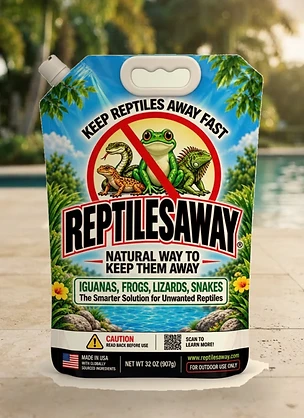
Label mockup shown. Final packaging may vary.
ReptilesAway Powder · 32 oz
1,500 SQ FT · 2–3 WEEKS PER APP$24.99


Label mockup shown. Final packaging may vary.
ReptilesAway Powder · 5-Gallon
30,000 SQ FT · 2–3 WEEKS PER APP$164.99
Three steps. You run them.
Find the travel lines
Walk your West Palm Beach property and flag the routes reptiles use — Flagler seawalls, canal banks, pool-cage edges, the gaps under a gate.
Lay the band
Shake a three-foot band of powder along those lines. No spray, no fogger, nothing to dry — fine around the pool and patio.
Reapply on schedule
One pass lasts two to three weeks. Reapply after a heavy rain or every couple of weeks through the long iguana season.
Questions about West Palm Beach.
My seawall on the Lake Worth Lagoon has iguana burrows behind it. Does the powder stop that?
It discourages iguanas from using the seawall cap and the bank behind it, which is where burrowing starts. Lay the band on the dry cap and the grass strip toward the house and reapply every two weeks in summer. Have a marine contractor check any cap that has already dropped or cracked.
Cane toads keep showing up on my Ibis pool deck at night. What do I treat?
The outside footer of the pool cage, the hedge on the lake side, and a ring around each low landscape light and the pool-equipment pad. Toads come up from the retention lake after rain and sit under lights. Keep the band fresh through wet season and keep dogs away from any toad you find.
How does a treatment visit work in a historic district like El Cid or Flamingo Park?
We walk the lot with you, mark the travel lines — seawall, hedges, porch lights, foundation — and send a quote for a single visit or a recurring schedule. There is no annual contract. Nothing is sprayed, so the coral-rock walls, tile, and plantings in the historic districts are not touched.
Take back your West Palm Beach yard.
From El Cid to the Ibis corridor, the fix is the same: a granular line where the reptiles travel. Run it yourself, or let our crew handle the whole thing.