
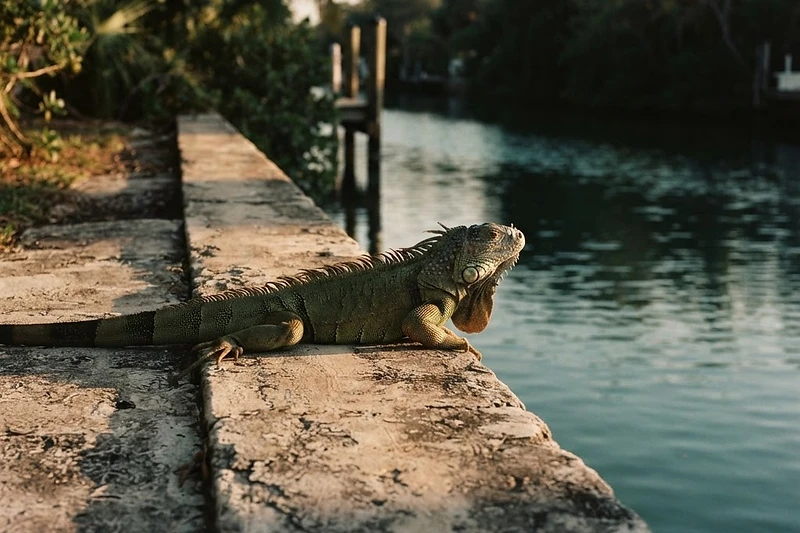
Iguanas are herbivores — they eat plants, not insects or meat. In a South Florida yard, they prefer soft, colorful, tender growth: hibiscus flowers, new bougainvillea bracts, impatiens blooms, and the tender tips of almost any shrub. A single adult iguana can strip a hibiscus to sticks in a day, and because they return to the same feeding spots daily, the damage compounds quickly. UF/IFAS publishes a list of iguana-resistant plants suited to South Florida conditions, and it is the best starting point if you are planning a landscape in iguana territory.
What iguanas eat vs what they leave alone
This list is drawn from UF/IFAS guidance and South Florida gardener experience. No plant is completely iguana-proof — a hungry iguana will try almost anything, especially in dry season when food is scarce. "Varies" means some reports show damage and others do not.
Frequently eaten
- Hibiscus — flowers and tender leaves; one of their absolute favorites
- Bougainvillea — bracts and new growth
- Orchids — flowers, especially ground-level species
- Roses — flowers and new shoots
- Impatiens — flowers and leaves
- Gardenia — flowers
- Coleus — leaves
- Banana plants — leaves and fruit
- Tomato plants — leaves and fruit
- Basil — leaves
- Pothos — leaves (common as an outdoor ground cover in South Florida)
- Spider plant — leaves
- Sea grape — leaves and fruit
Usually left alone
- Oleander — toxic to many animals; thick, leathery leaves
- Crown of thorns — spiny stems
- Snake plant — thick, fibrous, sharp-edged leaves
- Milkweed — milky sap; usually avoided
- Bromeliads — tough, spiny foliage; usually left alone
- Native ferns — fibrous, low nutritional value
- Plumbago — usually left alone
- Citrus — strong oils in leaves and peel; usually avoided
- Aloe — thick, spiky, bitter leaves
- Croton — varies; thick waxy leaves usually deter, but some report damage
- Ixora — varies; sometimes eaten
- Ginger — varies; sometimes eaten
- Lantana — usually avoided
If a plant you love is on the "frequently eaten" list, the most effective protection is physical — wrap the trunk with metal flashing so the iguana cannot climb it, or cage the plant with mesh until it is established. Plants on the "usually left alone" list are not guaranteed safe, but they are far less likely to be damaged.
Why do iguanas target the plants they do?
Iguanas target plants based on texture, moisture, and accessibility. They prefer soft, tender new growth over tough, mature leaves — which is why a freshly pruned hedge putting out new shoots is more attractive than an established one. They are drawn to bright colors (red, orange, pink flowers) and to plants with high water content, because iguanas get much of their hydration from what they eat. A flowering hibiscus near a sunny basking spot is the ideal target: food and water in one place, next to a warm surface to digest.
Plants they tend to avoid share certain traits: thick, waxy, or leathery leaves (oleander, croton), spiny or fibrous foliage (crown of thorns, snake plant), strong oils or sap (citrus, milkweed), and tough, fibrous texture (native ferns, bromeliads). This is not a perfect rule — a hungry iguana in a dry season will eat plants it normally ignores — but it is a reliable pattern that UF/IFAS guidance supports.
Do iguanas eat insects or meat?
No, iguanas are strict herbivores — they eat plants, not insects, rodents, or meat. Green iguanas do not eat bugs, other lizards, or people. They lack the teeth and digestive system for animal protein. If you see an iguana eating something that is not a plant, it is almost certainly nibbling on a fallen fruit or a flower that has attracted insects — the iguana is eating the plant matter, not the insects. This matters for gardeners: iguanas are not helping with pest control, and they are not attracted to your yard by an insect problem. They are attracted by the plants.
How to protect a vegetable garden from iguanas
A vegetable garden is a prime iguana target because tomatoes, basil, peppers, and leafy greens are all on their preferred list. The most reliable protection is physical exclusion: build a frame around raised beds and cover it with quarter-inch hardware cloth or mesh — not bird netting, which iguanas can push through because they are heavy. Bury the mesh a few inches into the ground so iguanas cannot push under it.
If a full cage is not practical, wrap individual plant trunks with metal flashing or tree wrap to prevent climbing, and pick fruit as soon as it ripens — fallen fruit is a major attractant. Remove any iguana-favored ornamental plants near the vegetable garden, because a hibiscus hedge next to your tomatoes is a billboard that says "food is here." Run a granular band along the fence line and the perimeter of the beds — the routes iguanas use to enter the garden. One application lasts two to three weeks.
Is replanting worth it?
Replanting with iguana-resistant species is the single most effective long-term strategy for a landscape under heavy iguana pressure. If you are starting fresh or replacing plants that iguanas have destroyed, choosing from the "usually left alone" list above — oleander, crown of thorns, crotons, bromeliads, lantana — will save you years of frustration and replacement costs.
But replanting an established garden is expensive and disruptive, and it is not always necessary. If the iguana pressure is moderate and seasonal, you may be able to protect the plants they love with physical barriers and a perimeter band, and leave the rest of the landscape alone. If the pressure is heavy and year-round — meaning multiple iguanas visit daily and have established burrows — replanting the most targeted plants is usually worth it, because no repellent or barrier will fully protect a hibiscus that an iguana has decided is its daily meal.
Using a perimeter band instead of replanting
If you are not ready to replant, a granular band along the routes iguanas use to enter the garden can reduce daily visits. Shake the powder along seawall caps, fence lines, foundation lines, and the transitions from landscaping to hardscape — the paths iguanas follow between basking spots and feeding areas. The band makes the route unpleasant, and over a few days the iguanas reroute to an easier path. One application lasts two to three weeks.
ReptilesAway is a granular powder — not a spray — that you shake along those travel routes. It is formulated as an EPA FIFRA 25(b) minimum-risk pesticide — made only from ingredients on the EPA's minimum-risk list, so it is exempt from federal registration. The 32 oz bag ($24.99) covers about 1,500 sq ft; the 5-gallon bucket ($164.99) covers about 30,000 sq ft. The five ingredients — sodium chloride, citric acid, lemongrass oil, peppermint oil, and garlic oil — are printed on every bag. Made in Fort Lauderdale, Florida, with a 30-day money-back guarantee. For local treatment in Miami-Dade, Broward, or Palm Beach, call 1-833-8REPTILES (1-833-873-7845) for a quote — no contracts.
Made with food-grade and botanical ingredients. As with any product, keep pets from eating it directly and check the ingredient list if your pet has known sensitivities to any of them.
Be honest: a perimeter band will not stop a determined iguana from reaching a plant it loves if there is an unobstructed path to it. The band works on travel routes, not on the plants themselves. Combine it with physical protection of high-value plants, and you have a practical defense that does not require replacing the entire landscape.
For the full species guide on iguana behavior and control, see our iguanas page.